Cistus creticus L. subsp. creticus, a member of the Cistaceae family, is widely known as the Cretan Rockrose. A common synonym in traditional botanical texts is Cistus villosus L. This aromatic shrub is a cornerstone of the Cyprus garrigue, famous for producing the sticky, balsamic resin known as ladanum from its leaves.
Cypriot names
Ξισταρκά, Λουβιδκιά, Λεούτιν, Λαδανιά, Κλαδίν, Κίστος ο κρητικός υποείδος ο κρητικός
Common English Names
The primary English name of Cistus creticus subspecies creticus is the Cretan Rockrose, or simply Rockrose. It is also frequently called the Ladanum Cistus due to its resin production.
Etymology of Cistus creticus subspecies creticus
The etymology of the genus name "Cistus" derives from the Ancient Greek "κίστος" [kistos], which in turn comes from "κίσθος" [kisthos]. This is the ancient Greek name of this plant, of unknown etymology; the word is considered a loan from an older dialect or language. "Creticus" means (of the island) "of Crete", where it was initially recorded.
Cistus creticus subspecies creticus in Cyprus
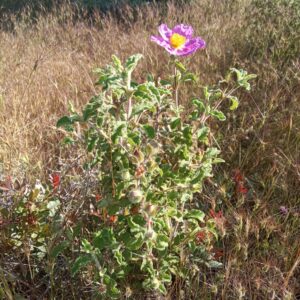
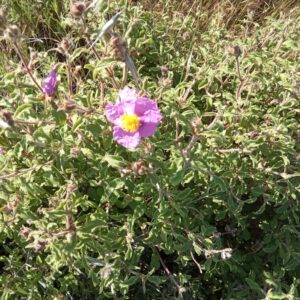
Cistus creticus subsp. creticus is a very common plant of South Cyprus, as it does not appear in the northern part. It appears up to an altitude of 1700 metres. It grows on the following uncultivated ground: roadsides, rocky places, dry hillsides and open woodland. Cistus creticus subsp. creticus' flowering period is from February until June.
Key Characteristics of Cistus creticus subsp. creticus
According to Meikle, this taxon is defined by the following unique combination of characters:
- Venation: The leaves are penninerved, featuring a single central midrib with lateral veins branching off like a feather.
- Glandular Stickiness: The plant is strongly viscid (sticky) and highly aromatic due to resin-secreting glandular hairs.
- Style Length: It possesses a distinct, elongate style (2.5–4 mm long) elevating the stigma above the ovary.
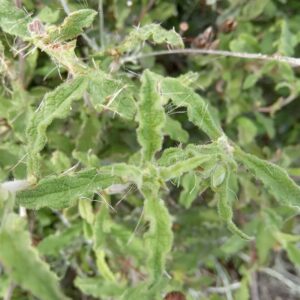
- Leaf Surface: The leaves are characteristically rugose (deeply wrinkled) with undulate or "crinkled" margins.
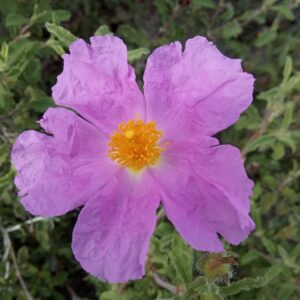
- Flower Size: Produces large, deep purple-pink flowers, usually 4–6 cm in diameter.
How to identify Cistus creticus subspecies creticus from other Cistuses
According to R.D. Meikle in his definitive Flora of Cyprus (Volume 1), distinguishing the polymorphism of the Cistus genus involves looking closely at the venation of the leaves, the length of the style, and the presence of glandular viscidity.
Cistus creticus L. subsp. creticus, a member of the Cistaceae family, is frequently referred to in older literature by the synonym Cistus villosus L. It is the primary source of the aromatic resin known as ladanum on the island.
Cistus creticus subsp. creticus vs. Cistus parviflorus
Meikle separates these two species primarily by the leaf venation and the length of the style. Cistus creticus subsp. creticus has penninerved leaves, while C. parviflorus has leaves that are distinctly longitudinally 3-nerved from the base. Additionally, the style in C. creticus is elongate, whereas in C. parviflorus, it is very short. Meikle separates these two species primarily by the leaf venation and the length of the style:
Venation: C. creticus subsp. creticus has penninerved leaves (pinnately veined). In contrast, C. parviflorus has leaves that are distinctly longitudinally 3-nerved from the base.
Style Length: C. creticus has an elongate style (2.5–4 mm long). In C. parviflorus, the style is very short (less than 0.5 mm), making the stigma appear almost sessile on the ovary.
Leaf Surface: The leaves of C. creticus are strongly rugose (wrinkled) with undulate or crisped margins. C. parviflorus leaves are typically grey-tomentose (covered in dense, matted grey hairs) and smoother in outline.
Glandular stickiness: According to Meikle, the glandular stickiness is the most immediate tactile way to separate these two, though it can be seasonally variable. In Cistus creticus subsp. creticus, the plant is described as being strongly viscid (sticky) and highly aromatic. This is due to a high density of peltate glandular hairs that secrete the heavy, balsamic ladanum resin.
In contrast, Cistus parviflorus is described by Meikle as being non-viscid or only very slightly glandular. Instead of the sticky resinous coating, its surfaces are covered in a dense, grey-tomentose indumentum. This means the leaves feel like soft, dry felt or "ashy" to the touch rather than tacky or gummy.
Key Differences in Stickiness and Texture
Resin Production: C. creticus is the primary source of ladanum; it will leave a noticeable, sweet-smelling residue on your fingers. C. parviflorus does not produce this resin in any significant quantity.
Tactile Feel: If you rub the leaf of C. creticus, it feels "rough" and "tacky." If you rub C. parviflorus, it feels "soft" and "velvety" because the star-shaped (stellate) hairs are much more prominent than any glands.
Aroma: C. creticus has a very strong, heavy scent even without crushing the leaves. C. parviflorus has a much fainter, more "herbal" or "dusty" smell.
Cistus creticus subsp. creticus vs. Cistus × pauranthus
Cistus creticus subsp. creticus is always strongly viscid and aromatic due to glandular hairs. In contrast, Cistus × pauranthus is not sticky. It is typically covered in a dense, soft, greyish-white tomentum but lacks the glandular resin-producing hairs that make the foliage of the Cretan Rockrose feel tacky. This hybrid (C. parviflorus × C. salviifolius) is often confused with Cistus creticus because of its pinkish flowers, but Meikle distinguishes them as follows:
Leaf Nerves: In Cistus creticus subsp. creticus, the leaves are strictly penninerved (a single main midrib with lateral veins branching off like a feather). In Cistus × pauranthus, the leaves inherit the trait of the C. parviflorus parent and are distinctly longitudinally 3-nerved from the base.
Glandular Stickiness: Cistus creticus subsp. creticus is always strongly viscid (sticky) and aromatic due to the presence of peltate glandular hairs that produce ladanum resin. Cistus × pauranthus is not sticky; it is typically covered in a dense, soft, greyish-white tomentum (matted hairs) but lacks the glandular resin-producing hairs that make the foliage feel tacky to the touch.
Cistus creticus subsp. creticus vs. Cistus × skanbergii
The hybrid Cistus × skanbergii is generally non-viscid, lacking the "gum" feel of the Cretan Rockrose. The nerves on the underside of C. creticus are "impressed" on top and very prominent below. Cistus × skanbergii has nerves often obscured by grey, felt-like hairiness, giving a much smoother texture. This hybrid (C. parviflorus × C. monspeliensis) is even more distinct when you look at the nerve structure and the nature of the indumentum:
Leaf Nerves: Cistus creticus subsp. creticus maintains its penninerved structure even on broader leaves. Cistus × skanbergii is consistently 3-nerved, though the nerves may be less prominent than in pure C. parviflorus due to the narrower leaf shape inherited from C. monspeliensis.
Glandular Stickiness: While C. monspeliensis (one of the parents) is famously sticky, the hybrid Cistus × skanbergii is generally non-viscid or only very slightly sticky at the very young tips. It lacks the persistent, heavy, balsamic "gum" feel that is present on all parts of Cistus creticus subsp. creticus.
Nerve Prominence: The nerves on the underside of Cistus creticus subsp. creticus are "impressed" (sunken) on the top and very prominent below. In Cistus × skanbergii, the nerves are often obscured by a dense, grey, felt-like hairiness that gives the leaf a much smoother texture than the wrinkled (rugose) leaf of the Cretan Cistus.
- Flower Color: Cistus × skanbergii bears small, pale pink flowers (2.5–3 cm) that resemble a wild rose, contrasting with the large, deep pink flowers of C. creticus (4-6 cm).
Is Cistus creticus Suitable For Gardens?
When asking "Is Cistus creticus Suitable For Gardens?", it is highly recommended for Mediterranean or xeriscape designs. Its large 4–6 cm flowers and rich, resinous aroma provide significant aesthetic value. The Cretan Rockrose requires very little water once established but demands excellent drainage and full sun.