Date Created: 08.04.2026
Last Modified: 09.04.2026
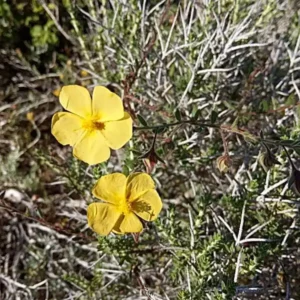
Fumana arabica (L.) Desf., the Arabian Rock-rose, is a woody-based perennial belonging to the Cistaceae family. It is also commonly known by the synonym Cistus arabicus L. This species is a frequent sight on rocky Mediterranean slopes, characterized by its bright yellow blossoms and resilient growth habit.
Cypriot Names
Φουμάνα η αραβική is the botanical translation. In the local dialect, it is called Περνίκκα [Perníkka], a term referring to small, woody shrubs, and Ξυσταρκά της πέτρας [Xystarká tis pétras], which means "Rock-rose of the stones," highlighting its preference for rocky limestone habitats.
Common English Names
- Arabian Rock-rose
- Mediterranean Rock-rose
- Yellow Fumana
- Arabian Fumana
Etymology of Fumana arabica
The etymology of the genus name Fumana comes from the Latin fumus, meaning smoke, which likely refers to the "smoky" or greyish-green hue of the leaves in certain species. The species name arabica is Latin for "from Arabia," designating its initial collection or descriptive range within the broader Eastern Mediterranean.
Synonyms
- Cistus arabicus L.
- Helianthemum arabicum (L.) Pers.
- Fumana viscidula ster.
- Fumana viscida Spach
- Fumana ferruginea (Lam.) Raf.
Key Characteristics for Diagnostic Identification
According to the definitive botanical keys established by Robert Desmond Meikle (1923–2021) in his comprehensive Flora of Cyprus, this species is distinguished from other local taxa by:
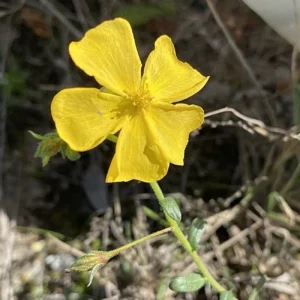
- Petal Length: Fumana arabica features the largest petals of the genus in Cyprus, measuring 8–10 mm (rarely 12 mm) long. In contrast, Fumana thymifolia and Fumana laevis have smaller petals, typically 5–8 mm long.
- Flower Arrangement: The flowers are mostly solitary and leaf-opposed. In Fumana thymifolia and Fumana laevis, the flowers are arranged in an elongate, bracteate cincinnus (a coiled, spike-like cyme).
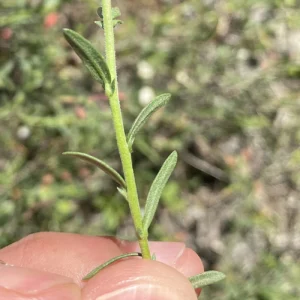
- Leaf Phyllotaxy: The leaves are alternate throughout the plant. This distinguishes it from Fumana thymifolia, where at least the lower leaves on the stem are strictly opposite.
- Pedicel Proportions: The pedicels (flower stalks) are notably long, often twice the length of the subtending leaves. In Fumana laevis, the stalks are shorter and the plant is generally hairless compared to the glandular-pubescent Fumana arabica.
- Growth Form: It forms a robust, branched undershrub with a persistent woody base, standing in contrast to the more delicate, often procumbent forms of Fumana thymifolia var. thymifolia.
Botanical Structure and Floral Details of Fumana arabica
The Floral Organs
The flowers are primarily solitary, emerging from the leaf axils. The five sepals are unequal, with the two outer ones being significantly smaller and narrower than the three inner ones. The long, slender style is curved at the base, terminating in a head-like stigma that is wider than the style itself.
Leaf Anatomy and Adaptations
The leaves are green and lack the dense white wool of some relatives, relying instead on glandular secretions. These glands produce a resinous substance that reduces water loss and acts as a deterrent to small insects. This adaptation is crucial for maintaining hydration on exposed limestone substrates during the Cypriot summer.
Capsule and Seeds
The fruit is a dry, three-valved capsule enclosed by the persistent inner sepals. Upon reaching maturity, the capsule opens to reveal several brown, angled seeds. These seeds possess a tough outer coat that allows them to endure long periods of dormancy until favorable moisture conditions trigger their germination.
Geographical Distribution and Habitat of Fumana arabica
The native range of this species extends across the Mediterranean Basin, including Southern Europe, North Africa, and Western Asia. It thrives in open, heliophilous environments such as phrygana, garigue, and sparse pine forests. It is particularly well-adapted to alkaline soils and rocky, uncultivated terrains.
Distribution in Cyprus
In Cyprus, the Arabian Rock-rose is an indigenous and ubiquitous plant found in all botanical divisions. It is especially prominent in the Akamas peninsula and the Troodos foothills. It occupies a wide altitudinal range, appearing from coastal sea cliffs up to elevations of approximately 1,100 meters.
Flowering Period in Cyprus
The flowering period for the Arabian Rock-rose in Cyprus is a quintessential spring event, typically lasting from February to May. The flowers are ephemeral, opening fully only in direct sunlight and often shedding their petals by midday. This ensures the plant maximizes pollination while minimizing moisture loss during peak heat.
Conservation Status in Cyprus
This species is not listed in the Red Data Book of the Flora of Cyprus. It is classified as "Least Concern" (LC) because it is widely distributed and its populations are stable. Its ability to colonize rocky and degraded soils makes it a resilient component of the island's native flora.
Is Fumana arabica Suitable for Gardens?
This species is an exceptional candidate for Mediterranean-style rock gardens and xeriscaping. Its brilliant yellow flowers provide early spring color, while its drought-hardy nature requires almost no supplemental irrigation once established. It must be planted in a sunny location with sharp drainage and alkaline-leaning soil.
Medicinal and Practical Properties
While not as commercially utilized as Cistus, this species is rich in secondary metabolites like tannins and flavonoids. In traditional Mediterranean medicine, infusions of related species were occasionally used for their astringent properties. However, in Cyprus, it is primarily appreciated for its ecological role and beauty.
The plant serves as a vital component of the garigue ecosystem, providing nectar for early-season bees and preventing soil erosion on steep, rocky inclines. Its symbiotic relationship with mycorrhizal fungi allows it to mine nutrients from poor soils, effectively acting as a pioneer species that stabilizes the harsh limestone landscape.
Fascinating Insights About Fumana arabica
The Morning Bloom
The flowers of Fumana arabica are famously short-lived. A bloom that opens at 8:00 AM may have already dropped its petals by noon. This rapid cycle is a strategic energy-saving measure, focusing all reproductive efforts on the hours when pollinators are most active and the sun is least intense.
Sticky Shields
The "viscid" nature of the stems acts as a "flypaper" defense. Small crawling insects that might steal nectar without pollinating the flower often get stuck to the glandular hairs. This ensures the plant's resources are reserved for flying insects like bees that can effectively transfer pollen between distant shrubs.
Fire-Stimulated Life
The seeds are known for their physical dormancy, which can be broken by the heat of a wildfire. In the fire-prone Mediterranean landscape, this trait allows the Arabian Rock-rose to be among the first plants to reappear after a burn, colonizing the newly cleared, nutrient-rich ground.
Invisible Partnerships
Underneath the soil, the roots of this Rock-rose often host truffles and other fungi. This mycorrhizal association is a masterclass in survival; the fungi provide water and minerals to the plant, while the plant provides sugars. This partnership is what allows it to stay green on a sun-scorched limestone rock.
The "Smoke" Plant
Despite the bright yellow flowers, the name "Fumana" keeps the plant's etymological mystery alive. The "smoky" appearance of the foliage is most visible at dawn when the dew clings to the glandular hairs, creating a hazy, ethereal look that disappears as soon as the sun dries the leaves.