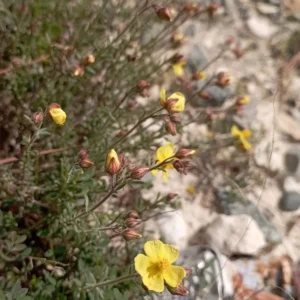
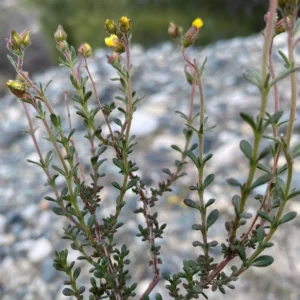
Fumana thymifolia is a dwarf, woody subshrub in the Cistaceae family. Unlike many other members of its genus, which have needle-like leaves, this species is characterised by its small, broader leaves and its viscid (sticky) nature. In Cyprus, it is a pioneer species that colonizes open, stony ground, providing a vibrant yellow display from the very start of the year.
Cypriot names
Φουμάνα η θυμαρόφυλλη
Common English Names
The most accurate English name is the Thyme-Leaved Rockrose or Thyme-Leaved Fumana. These names identify its membership in the Rockrose family while acknowledging its specialized foliage. In regional Mediterranean guides, it is sometimes called the Sticky Rockrose due to the glandular hairs that cover its leaves and stems.
Etymology of Fumana thymifolia
The etymology of the name "Fumana" derives from the Latin "fumus", meaning "smoke", hence, fumana is "smokey", referring to the color of its foliage. The species epithet "thymifolia" (thyme-leaved) refers to the leaf size and arrangement - small and densely packed - rather than a linear shape. It describes the "look" of a thyme bush from a distance.
Synonyms and Taxonomic History
This plant has a complex naming history due to its variable leaf shape. Common synonyms include Helianthemum thymifolium and Cistus thymifolius. Some older texts also use Fumana viscida, which was an attempt to prioritize its sticky texture over its leaf shape in the scientific naming process.
Botanical Structure and Morphology
Dwarf Shrubby Growth Habit
Fumana thymifolia is a low, much-branched subshrub reaching up to 30 cm in height. It has a woody base and erect or ascending stems. How to recognize its growth? It typically forms a small, rounded mound. The branches are often covered in fine, sticky hairs that trap dust, giving the plant a "smoky" appearance.
Obovate and Glandular Foliage
Correcting common misconceptions, the leaves of Fumana thymifolia are oblanceolate to narrowly obovate. They are generally less than 1 cm long and are densely covered in glandular hairs (pubescent). How to recognize them? They are broader towards the tip, often feel sticky (viscid) to the touch, and are arranged oppositely along the stem.
Bright Yellow Fugacious Flowers
The flowers consist of five bright yellow petals, often with a faint orange or reddish blotch at the base. A fascinating fact is that these flowers are "fugacious," meaning they last only a few hours. How to tell it apart? The flower stalks (pedicels) are significantly longer than the leaves and are also covered in sticky, glandular hairs.
Geographical Distribution
This member of the Cistaceae family is native to the entire Mediterranean region, from Portugal and Morocco in the west to Israel and Syria in the east. It is a staple of the "Stenomediterranean" flora, meaning it is strictly bound to the climates of the Mediterranean basin.
Distribution Across Cyprus
In Cyprus, Fumana thymifolia is widespread and common. It is found throughout the Akamas Peninsula, the Limassol hills, and the lower zones of the Troodos range. It is highly adaptable, appearing from sea level in coastal "phrygana" up to approximately 900 meters in altitude on rocky limestone slopes.
Flowering Period in the Cypriot Climate
Since it appears in January, it represents the very beginning of the season. In Cyprus, it typically flowers from January to June, with the most intense bloom occurring in March. Its ability to flower in the middle of winter is a key survival strategy to attract early pollinators.
Habitat and Ecological Preferences
Rocky Phrygana and Coastal Scrub
This plant thrives in dry, sunny, and open habitats. It is a classic inhabitant of "phrygana" (low, thorny scrubland) and "garrigue." How to find its habitat? Look for limestone-rich soils, rocky slopes, and even sandy areas near the coast where competition from larger plants is minimal.
Adaptation to Aridity
The sticky, glandular hairs on the leaves are a sophisticated defense against the heat. These hairs create a "boundary layer" of still air around the leaf, reducing evaporation. Additionally, the resins in the hairs make the plant unpalatable to herbivores like goats, which are common in the Cypriot countryside.
Toxicity and Protective Defenses
While not toxic to humans, Fumana thymifolia is chemically protected. The glandular secretions contain terpenes and resins that give it a bitter taste. This ensures that while other plants are overgrazed, the Thyme-Leaved Rockrose remains relatively untouched, allowing it to dominate in heavily grazed landscapes.
How to identify Fumana thymifolia
Its flowers appear in an elongate, bracteate cincinus (not solitary as in arabica); its petals are 5-8 mm long. It has leaves densely glandular-pubescent, oblanceolate or narrowly obovate, generally under 1 cm. Its distinct difference with the Fumana laevis species that has the same flowers are the leaves: oblanceolate or narrowly obovate in thymifolia, linear in laevis.
Distinguishing Characteristics: Fumana vs. Helianthemum, Sister Genera That Resemble
While Fumana thymifolia bears a striking visual resemblance to the Sunroses of the genus Helianthemum - particularly due to their shared five-petaled yellow flowers and woody base - several key botanical features set them apart. The most definitive difference lies in the stamens; in Fumana, the outer stamens are sterile and lack anthers, appearing as short, hair-like filaments, whereas all stamens in Helianthemum are fertile and bear anthers. Furthermore, the leaves of most Helianthemum species are broader and possess prominent, leaf-like stipules at the base of the leaf stalk, which are generally absent in Fumana thymifolia. Additionally, while Helianthemum species often have flowers arranged in dense, one-sided racemes, Fumana tends to produce flowers on much longer, more slender pedicels that give the plant a more "airy" and less structured appearance.