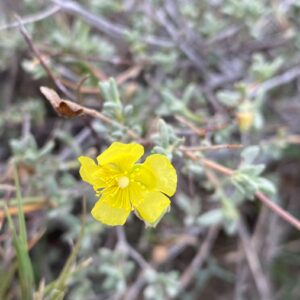
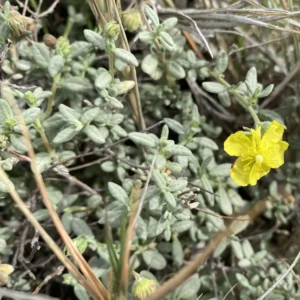
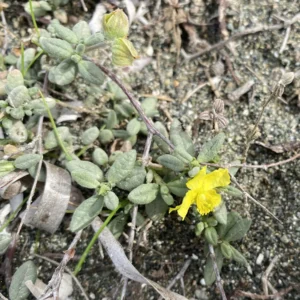
The Stipulated Sunrose, or Helianthemum stipulatum, is a resilient, woody subshrub that thrives within the arid coastal regions of the Mediterranean basin. This species is particularly well-adapted to the high salinity and intense sunlight found along the sandy shores of Cyprus. Its compact growth habit allows it to withstand the powerful winds that frequently sweep across the maritime landscape.
Cypriot names
Ηλιάνθεμον το στιπολωτό
Common English Names
In English botanical circles, this hardy plant is most frequently referred to as the Stipulated Sunrose. Some regional guides also call it the Desert Sunrose because of its impressive ability to survive in extremely dry and sandy environments. These names highlight the plant's robust nature and its specialized botanical features.
Etymology of Helianthemum stipulatum
The etynology of the genus "Helianthemum" comes from the Greek words "ἥλιος" (helios, pronounced HEE-lee-oss), meaning sun, and "ἄνθεμον" (anthemon, pronounced AN-the-mon), meaning flower. The species epithet is the Latin "stipulatum", which refers to the prominent appendages at the base of the leaves. These specific terms describe its sun-seeking behavior and morphology.
Synonyms and Historical Naming
This species has been documented under several different names as botanical classifications have evolved over the last century. Common synonyms found in older literature include Helianthemum ellipticum and Helianthemum ledifolium. It was occasionally placed in the genus Cistus before researchers moved the smaller-flowered sunroses into their own distinct group.
Key Characteristics vs Other Helianthemum
To successfully identify the Stipulated Sunrose among its many relatives, you must look closely at several distinct morphological details that separate it from other Mediterranean sunroses:
- Presence of Stipules: Unlike some members of the genus, this plant has very prominent, linear-lanceolate stipules at the base of each leaf stalk that are nearly as long as the leaf itself.
- Silver Tomentose Foliage: The leaves are not green but appear distinctly silver or white-grey due to a dense, felt-like covering of stellate hairs.
- Flower Structure: The inner three sepals are strongly ribbed and much larger than the outer two, a feature more pronounced in this species than in the more common H. salicifolium.
- Inflorescence: The flowers are arranged in a "scorpioid cyme," meaning the flowering stem curves slightly like a scorpion's tail before the yellow petals unfurl.
Helianthemum stipulatum looks similar to Fumana thymifolia - Key differences
While both share yellow flowers (for Helianthemum vivid, for Fumana thymifolia dull), the Stipulated Sunrose is easily distinguished from Fumana thymifolia by its reproductive and leaf traits. The most reliable check is the stamens; in Helianthemum, all stamens are fertile and bear anthers, whereas Fumana has an outer ring of sterile, hair-like stamens. Furthermore, the Stipulated Sunrose has leaves that are elliptic and silver-grey, whereas Fumana usually has greener, stickier foliage.
Botanical Structure
Compact Woody Habit
The Stipulated Sunrose typically grows to a height of ten to forty centimeters, forming dense and rounded tufts. Its base is distinctly woody, providing a sturdy anchor in shifting sands or rocky crevices near the sea. This structural integrity is vital for the plant to remain stable during storms.
Silver Protective Foliage
The leaves are small and elliptic, covered in a dense layer of velvety white-grey hairs that provide a silver appearance. These hairs are a critical adaptation for reflecting solar radiation and reducing moisture loss through evaporation. At the base of each leaf, the linear appendages are clearly visible to observers.
Golden Yellow Blooms
The flowers feature five delicate yellow petals that surround a central cluster of numerous fertile stamens which produce abundant pollen. These blooms are arranged in one-sided clusters that unfurl gradually as the flowering season progresses throughout the spring. The inner sepals are significantly larger and more ribbed than others.
Geographical Distribution
Regional Mediterranean Range
This member of the Rockrose family has a broad distribution that spans from the Canary Islands across North Africa to the Levant. It is a specialist of heat-loving zones, rarely straying far from the warmth provided by the Mediterranean Sea. Its range reflects a high tolerance for specific climatic conditions.
Distribution Across Cyprus
In Cyprus, the Stipulated Sunrose is primarily found on the sandy beaches of the Akamas Peninsula and the dunes of Ayia Napa. It thrives at low altitudes, usually from sea level up to one hundred and fifty meters. You will often find it growing in areas with high light.
Seasonal Flowering Period
The flowering period begins as early as January or February and continues through the month of May in the mild Cypriot climate. The petals open in response to the morning sun but often drop by the early afternoon as temperatures rise. This timing ensures the plant utilizes essential winter moisture.
Habitat and Ecology of Helianthemum stipulum
Coastal Sand Preferences
This plant is a specialist of sand-loving plant communities that grow on stabilized dunes or maritime limestone rocks near the shoreline. It thrives in open, salty environments where the porous soil allows for excellent drainage after heavy rains. The salt spray acts as a natural barrier against competing vegetation.
Extreme Environmental Adaptation
Its silver foliage and thick root system make it an extremophile capable of enduring conditions that would dehydrate most other plants. The ability to process and excrete excess salts allows it to remain vibrant even in the height of the dry season. This resilience makes it a hardy coastal survivor.
Is Helianthemum stipulatum Suitable For Gardens?
Many enthusiasts ask, "Is Helianthemum stipulatum Suitable For Gardens?" In Cyprus, it is an excellent choice for coastal rockeries or xeroscaping projects due to its minimal water requirements. It must be planted in extremely well-drained, sandy soil and requires full sun to maintain its compact shape and color.