Date Created: 17.12.2022
Last Modified: 03.10.2026
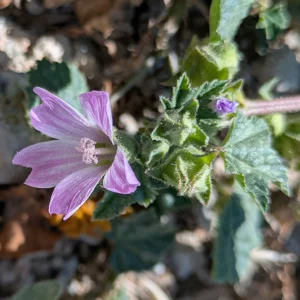
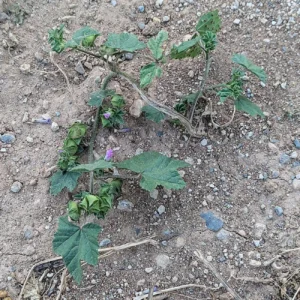
Malva multiflora, commonly known as the Cornish Mallow or Cretan Mallow, is a robust annual or biennial herb belonging to the Malvaceae family. Reaching heights of up to 2 meters, it is a prominent feature of the Cypriot landscape, favored for its resilience in arid conditions and its delicate, mauve-veined blossoms.
Common Cypriot Names
The formal botanical translation in Modern Greek is Μολόχα η πολύανθος [Moloha i polianthos]. In Cyprus, it is widely referred to as Μολόχα [Moloha], a name with roots in the Ancient Greek "μαλάχη" [malakhi], referring to the plant's emollient (softening) properties.
Common English Names
- Cornish Mallow
- Cretan Mallow
- Smaller Tree Mallow
- Cretan Hollyhock
Etymology of Malva multiflora
The etymology of the genus "Malva" originates from the Ancient Greek "μαλάχη" [malache], which may derive from the verb "μαλάσσω" [malasso], meaning "to soften, soothe", referring to the leaves and an ointment made from the seeds which were supposed to be soothing to the skin. The epithet "multiflora", comes from New Latin and means "having many flowers", as its flowers appear in clusters. Similarly, in Cyprus, another four species have flowers in clusters (sylvestris, nicaeensis, parviflora and neglecta).
Synonyms
- Lavatera multiflora Cav. (1786)
Key Characteristics for Diagnostic Identification
According to the definitive botanical keys established by Robert Desmond Meikle in his comprehensive Flora of Cyprus (Volume 1, 1977), this species is distinguished from other taxa of the genus in Cyprus (where it was historically classified as Lavatera cretica) by the below morphological features:
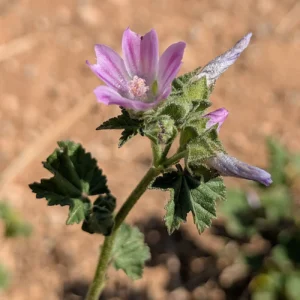
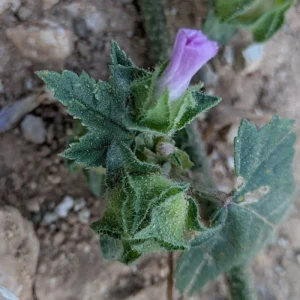
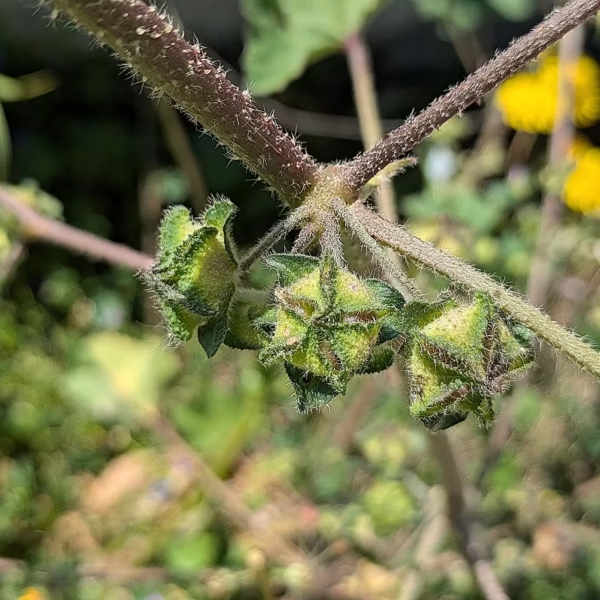
- Epicalyx Segments: The most critical diagnostic SOS identifier is that the three epicalyx segments are broadly ovate-deltoid (triangular) and distinctly fused at the base. This is the primary feature that separates it from Malva sylvestris (with which it resembles a lot), Malva parviflora, and Malva nicaeensis, all of which possess narrow, linear to lanceolate epicalyx segments that are free to the base. Only Malva punctata and Malva unguiculata share fused epicalyx segments, but they differ in habit and petal size.
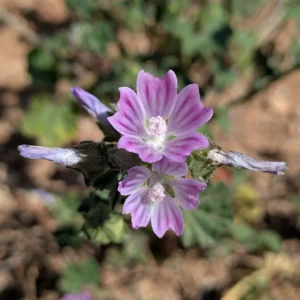
- Petal Dimensions: The petals of Malva multiflora measure approximately 15 mm in length. This distinguishes it from Malva sylvestris, which has significantly larger petals (20–30 mm) that are at least three times the length of the calyx. It also separates it from Malva nicaeensis and Malva neglecta, which have much smaller petals (7–12 mm).
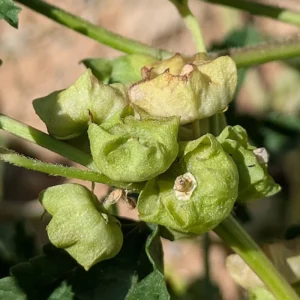
- Fruit (Mericarps) Morphology: The dorsal surface of the mericarps is smooth or only very obscurely ridged with rounded margins. This is a definitive contrast to Malva sylvestris and Malva parviflora, where the fruit segments are strongly reticulate (pitted like a honeycomb) and often have winged or sharp-angled margins.
- Indumentum: The stems and petioles are sparsely to moderately pubescent with simple or stellate hairs. This differs from Malva parviflora, which is often nearly glabrous (hairless), and Malva sylvestris, which typically has more aggressive, spreading hairs.
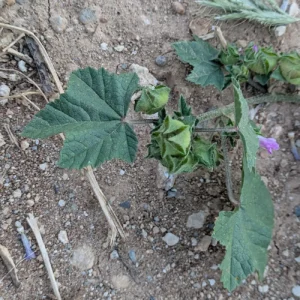
- Growth Habit and Size: While it can reach 2 meters in optimal conditions, in dry habitats it often remains prostrate or decumbent (sprawling), reaching roughly 30 cm in length. This sprawling habit is typical of Malva nicaeensis, but Malva multiflora is distinguished by its shorter, unequal pedicels in each cluster, whereas Malva sylvestris has long, more equal pedicels.
Additional Identification Characteristics
Botanist Georgios Hadjikyriakou notes that the deltoid shape of the epicalyx becomes even more apparent as the fruit matures. The broad bracts act as a protective envelope for the developing seeds, a structural trait less pronounced in the narrow-bracted Malva sylvestris.
Furthermore, Malva oxyloba has linear epicalyx segments.
Botanical Structure and Floral Details of Malva multiflora
Growth Habit and Size
Malva multiflora typically grows upright, reaching heights between 30 and 200 centimeters. Its stems are often woody at the base and covered in fine, star-shaped hairs. This structural integrity allows the plant to compete effectively for sunlight in crowded meadow environments or alongside roadside hedges.
Foliage and Leaf Structure
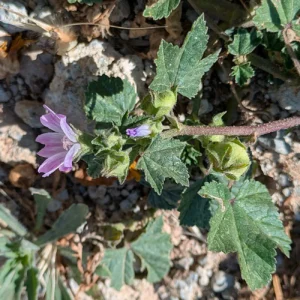
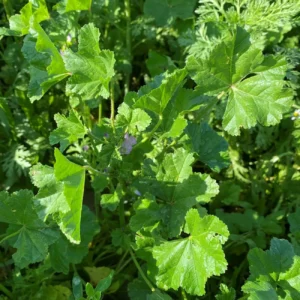
The leaves of Malva multiflora are palmately lobed, featuring five to seven shallow divisions. They are generally circular or heart-shaped at the base with serrated edges. These soft, hairy leaves are arranged alternately along the stem, providing a lush, green appearance even in poor soil.
Floral Arrangement
The flowers occur in axillary clusters of 2–8. The pedicels are notably shorter than the subtending leaf stalks (petioles), which creates the "clustered" look characteristic of the species. The petals are lilac to pale pink with 3–5 darker veins, a classic mallow color pattern.
Leaf Solar Tracking
The leaves of the Cretan Mallow are suborbicular-cordate with 5–7 shallow lobes. Research by Schwartz and Koller (1986) demonstrated that these leaves exhibit diurnal phototropism, essentially "tracking" the sun to maximize photosynthesis in the intense Mediterranean light.
Geographical Distribution and Habitat of Malva multiflora
Native to the Mediterranean Basin, North Africa, and Western Europe, the Cretan Mallow is highly adapted to disturbed soils, waysides, and agricultural margins. It is a classic "therophyte" (annual) that survives the summer heat by completing its life cycle before the soil moisture is entirely depleted.
Distribution in Cyprus
The plant is 100% verified across all phytogeographical regions of Cyprus. It is exceptionally common in the lowlands of Limassol, Paphos, and the Mesaoria plain, often forming dense stands along field edges and rocky waste ground.
Elevation Range in Cyprus
In Cyprus, this species is found from sea level up to approximately 900 meters. It is most prevalent in the coastal and inland plains below 300 meters.
Flowering Period in Cyprus
The flowering window is strictly seasonal, occurring from February to May.
Conservation Status in Cyprus
The Red Data Book of the Flora of Cyprus classifies this species as Least Concern (LC). It is an opportunistic colonizer and remains one of the most successful and widespread members of the Malvaceae family on the island.
Is Malva multiflora Suitable for Gardens?
While attractive, it is often viewed as a "weed" due to its rapid growth. Seeds are occasionally available through specialist wildflower nurseries.
Toxicity and Safety
The Cornish Mallow is generally considered safe for human contact and consumption. However, studies published by ResearchGate (Dodd and Henry) indicate that related mallows like Malva parviflora can cause "staggers" in livestock if grazed in extreme quantities due to cyclopropene fatty acids. No such severe toxicosis is documented for Malva multiflora in humans, though it is known to accumulate nitrates from over-fertilized soils, which can be harmful if large quantities are ingested.
Medicinal Properties
Emollient and Anti-inflammatory Uses
According to research in the Journal of Ethnopharmacology, mallows are rich in mucilage and flavonoids. These compounds provide a protective layer over mucous membranes, making the plant a traditional remedy for sore throats, dry coughs, and gastrointestinal irritation. The leaves are typically prepared as a soothing tea or decoction.
Dermatological Applications
Expert ethnobotanists like Diego Rivera suggest that crushed mallow leaves have been used for centuries as poultices for skin burns, insect bites, and abscesses. The mucilage acts as a natural moisturizer and mild analgesic, facilitating faster tissue recovery and reducing localized swelling.
Fascinating Insights About "Malva multiflora"
Solar Tracking Seeds
The leaves are not the only parts that respond to light. The plant's ability to maximize sun exposure allows it to produce high concentrations of sugars, which are directed into the seeds, ensuring they can remain viable in the soil for several years during drought cycles.
The "Bread-and-Cheese" Plant
In European folklore, the green, disc-shaped fruits of Malva species are often called "cheeses." Children in Cyprus and across the Mediterranean have historically foraged these green seeds as a nutty, nutritious snack, rich in protein and mucilage.
The Pope's Mallow
Historically, the distinction between Malva and Lavatera was a point of intense debate among early botanists. The Cretan Mallow was a primary subject of these studies, leading to the eventual molecular reclassification that moved it from Lavatera to Malva, a shift supported by its closer genetic affinity to common mallows.
Natural PH Indicator
The anthocyanins (pigments) in the petals are highly sensitive to pH changes. A tea made from the flowers will turn from purple to green if an alkaline substance is added, a property used by historical herbalists to test the "purity" of water sources.