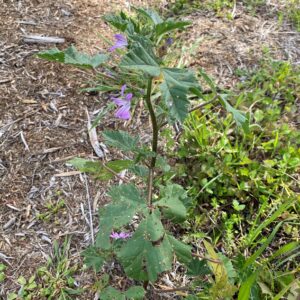
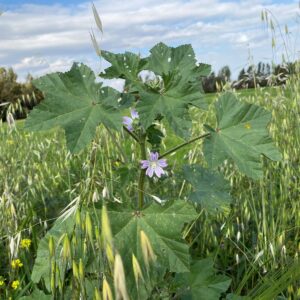
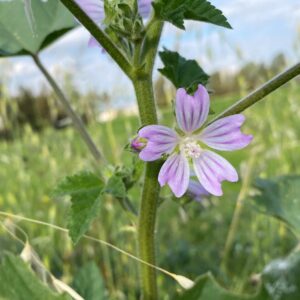
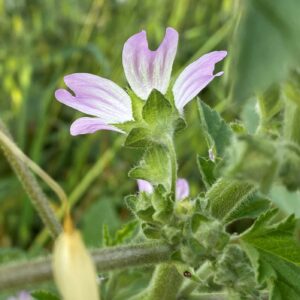
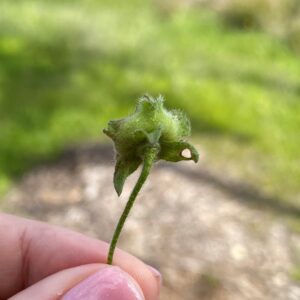
Historically known as Lavatera cretica, Malva multiflora is a robust annual or biennial herb. It belongs to the Malvaceae family and is native to the Mediterranean basin. It has successfully naturalized in various temperate regions globally, often found thriving in disturbed soils, coastal areas, and fields.
Cypriot names
Μολόχα, Μαλάχη η πολυανθής
Etymology of Malva multiflora
The etymology of the genus "Malva" originates from the Ancient Greek "μαλάχη" [malache], which may derive from the verb "μαλάσσω" [malasso], meaning "to soften, soothe", referring to the leaves and an ointment made from the seeds which were supposed to be soothing to the skin. The epithet "multiflora", comes from New Latin and means "having many flowers", as its flowers appear in clusters. Similarly, in Cyprus, another four species have flowers in clusters (sylvestris, nicaeensis, parviflora and neglecta).
Botanical Characteristics
Growth Habit and Size
Malva multiflora typically grows upright, reaching heights between 30 and 200 centimeters. Its stems are often woody at the base and covered in fine, star-shaped hairs. This structural integrity allows the plant to compete effectively for sunlight in crowded meadow environments or alongside roadside hedges.
Foliage and Leaf Structure
The leaves of Malva multiflora are palmately lobed, featuring five to seven shallow divisions. They are generally circular or heart-shaped at the base with serrated edges. These soft, hairy leaves are arranged alternately along the stem, providing a lush, green appearance even in poor soil.
Habitat and Distribution
Preferred Environment
Malva multiflora thrives in nitrogen-rich environments. You will commonly find it in "ruderal" sites, such as waste grounds, construction areas, and farmyards. It prefers full sun but can tolerate partial shade, provided the soil remains relatively moist during its primary spring growing season.
Geographic Range
While native to Southern Europe and North Africa, Malva multiflora has traveled far. It is now widely distributed across California, parts of Australia, and Western Europe. Its ability to produce numerous seeds allows it to colonize new territories rapidly, sometimes being classified as an invasive weed.
Malva multiflora in Cyprus
Malva multiflora is a common plant in Cyprus, encountered all around the island up to an altitude of 1075 metres. It primarily grows in uncultivated fields. Its flowering period is between December and May.
Ecological and Practical Uses
Pollinator Attraction
The nectar-rich blossoms of Malva multiflora are a magnet for biodiversity. Bees, butterflies, and hoverflies frequently visit the flowers for sustenance. By supporting these insects, the plant plays a vital role in maintaining the health of local ecosystems and helping pollinate nearby crops or gardens.
Culinary Potential
Like many of its relatives, Malva multiflora is entirely edible. The young leaves can be eaten raw in salads or cooked similarly to spinach. They have a mild flavor and a slightly mucilaginous texture, which makes them excellent for thickening soups and traditional Mediterranean stews.
Medicinal Properties
In traditional herbal medicine, Malva multiflora is utilized for its soothing mucilage. It is often brewed into teas to treat inflammatory conditions of the respiratory and digestive tracts. The plant's emollient properties also make it useful for topical poultices to calm irritated or burnt skin.
Growing and Management
Seed Dispersal
The fruit of Malva multiflora is a schizocarp, often called a "cheese" due to its wheel-like shape. When ripe, it breaks into several single-seeded segments. These seeds are long-lived in the soil, allowing Malva multiflora to reappear year after year even after clearing.
Propagation Tips
If growing Malva multiflora intentionally, sow seeds directly into the soil during autumn or early spring. They require little maintenance once established. Because the plant is so hardy, it rarely suffers from pests or diseases, though it may occasionally host common mallow rust fungi on its leaves.
Weed Control
For gardeners, Malva multiflora can become quite aggressive. If you wish to control its spread, it is essential to pull the plants before they set seed. Its deep taproot can make removal difficult once the plant matures, so early intervention is usually the best strategy.
Persistence in the Landscape
The resilience of Malva multiflora makes it a symbol of endurance. Whether viewed as a beautiful wildflower or a stubborn weed, its ability to provide food, medicine, and habitat in harsh conditions is remarkable. It remains a staple of Mediterranean flora and a fascinating study in botanical adaptation.
How to identify Malva multiflora
Besides the flowers, the key to identifying the Malva species whose flowers look similar is primarily the epicalyx (a smaller calyx preceding the calyx). The best-observed epicalyx is the one seen after the flower falls and is replaced by the fruit. Malva multiflora has a similar flower to aegyptia, sylvestris, parviflora and nicaeensis. Multiflora has a deltoid epicalyx, sylvestris has a linear/filiform epicalyx, parviflora has a linear epicalyx, and nicaeensis has an obovate epicalyx. Aegyptia is very small with different leaves.
Additionally, multiflora has smaller pink flowers, with about 1.5 cm long petals, and it is the tallest of the Cyprus species, it may reach between 30 - 200 cm high, and in contrary to sylvestris, it has a slightly pubescent stem and petioles. Sylvestris has petals 15-20 mm long and an epicalyx with ovate or broadly lanceolate or oblanceolate segments. Malva aegyptia has similar flowers but they are solitary and the plant reaches up to 15 cm high. Malva parviflora is very similar to multiflora, its petals are 15-20 mm long, the plant is between 30-150 cm high, but it has a characteristic epicalyx with linear or filiform segments that multiflora doesn't have. Malva nicaeensis has similar flowers but its petals are only 7-10 mm long and the plant is between 7-40 cm high.