Date Created: 24.02.2023
Last Modified: 13.05.2026
Malva parviflora, commonly known as the Small-flowered Mallow, is a hardy annual or biennial herb in the Malvaceae family. Recognized for its inconspicuous blossoms and disc-like fruits, it is a frequent sight in the disturbed soils and agricultural margins of Cyprus, blooming vigorously in early spring.
Common Cypriot Names
The formal botanical translation in Modern Greek is Μολόχα η μικρανθής [Moloha i mikranthis]. In Cyprus, it is locally called Χαμομολόχα [Hamomoloha], a descriptive name meaning "low-growing mallow" (from "hamo", on the ground), referring to its typical prostrate or spreading growth habit compared to its taller relatives.
Common English Names
- Small-flowered Mallow
- Cheeseweed
- Little Mallow
- Marshmallow (though inaccurate, used colloquially)
Etymology of Malva parviflora
Etymology of Malva parviflora: The Latin name of the genus "Malva" originates from the Ancient Greek "μαλάχη" [malache], which may derive from the verb "μαλάσσω" [malasso], meaning "to soften, soothe", referring to the leaves and an ointment made from the seeds which were supposed to be soothing to the skin. The epithet "parviflora", is a compound word that comes from the Latin "parva'', meaning "small'', and "flora", meaning "flower", hence "bearing small flowers", referring to the size of its flowers which is considered smaller than other species.
Synonyms
No homotypic synonyms for this taxon are provided, as Malva parviflora has remained consistently classified under this name since its description by Linnaeus in 1753.
Key Characteristics for Diagnostic Identification
According to the definitive botanical keys established by Robert Desmond Meikle in his comprehensive Flora of Cyprus (Volume 1, 1977), this species is distinguished from other taxa of the genus in Cyprus by the below morphological features:
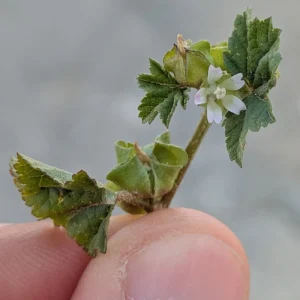
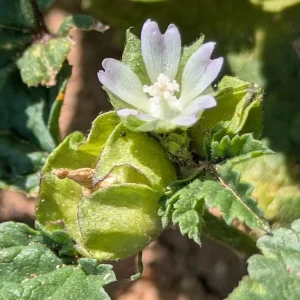
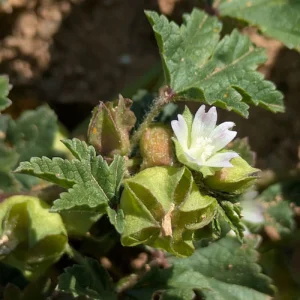
- Petal Length and Visibility: The most SOS diagnostic identifier is the extremely short petals, which measure only 3–5 mm in length. These petals barely exceed the calyx or are sometimes shorter than it. This separates it from Malva sylvestris (20–30 mm), Malva multiflora (15 mm), Malva nicaeensis (7–12 mm), and Malva neglecta (10–12 mm), all of which have petals clearly and conspicuously exceeding the calyx.
- Petal Color: The petals are consistently white or very pale pink/lilac, often lacking the dark, dramatic veins found in Malva sylvestris. While Malva neglecta can also be pale, its petals are significantly longer and deeply notched at the apex.
- Epicalyx Segment Shape: The 3 epicalyx segments are linear or linear-lanceolate and are much shorter than the calyx-lobes. This distinguishes it from Malva nicaeensis, which has ovate or lanceolate segments, and Malva multiflora, which has broadly ovate-deltoid segments that are fused at the base. Malva sylvestris features linear or oblong-lanceolate segments that are nearly as long as the calyx-lobes, whereas Malva neglecta possesses linear or linear-lanceolate segments that are simply shorter than the lobes. Malva oxyloba shares the linear segment shape but is distinguished by its deeply divided foliage. Malva punctata and Malva unguiculata deviate significantly from the others; both possess broadly ovate-cordate segments that are fused at the base to form a distinct cup. While this fused trait is shared with Malva multiflora, the segments in M. punctata are notably larger and more leaf-like, further separating them from the narrow, free segments of the M. parviflora and M. sylvestris groups.
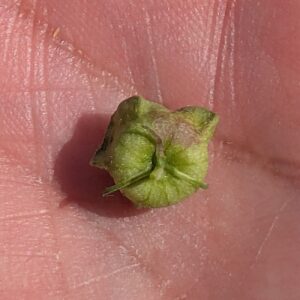
- Fruit (Mericarps) Morphology: The dorsal surface of the mericarps is strongly reticulate (pitted) and, most importantly, the margins are distinctly winged or dentate (toothed). This winged margin is a unique identifier; in Malva sylvestris and Malva neglecta, the margins are rounded or only slightly angled without any wings.
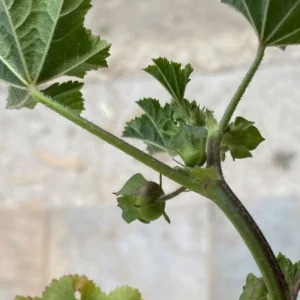
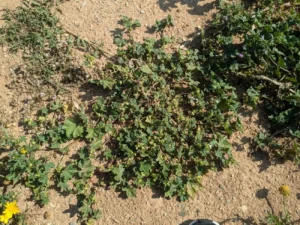
- Growth Habit: The plant is typically prostrate or spreading (decumbent), with stems trailing along the ground up to 50 cm. This is a stark contrast to Malva sylvestris, which is primarily erect and robust, often reaching 1.5 meters in height. Malva multiflora can be both spreading and erect but is generally much larger and more vigorous.
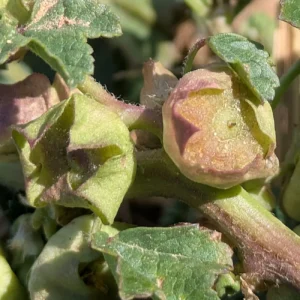
- Calyx Behavior in Fruit: Upon fruiting, the calyx becomes greatly enlarged, papery, and spreading, often exposing the ring of seeds. In Malva neglecta and Malva nicaeensis, the calyx remains more or less erect or closely invests the fruit without such dramatic enlargement.
Additional Identification Characteristics
Botanist Georgios Hadjikyriakou observes that Malva parviflora is often the most "refined" in appearance among the mallows due to its glabrescent (becoming hairless) stems. Unlike the bristly Malva sylvestris, this species often appears smooth or only sparsely hairy, especially in older specimens found in dry Cyprus lowlands.
In addition, Malva oxyloba is distinguished by upper leaves that are deeply palmatisect, split into 3–5 narrow, linear-oblong segments. This gives the plant a skeletal appearance compared to Malva sylvestris or Malva parviflora, which feature broad, suborbicular leaves with only shallow, rounded lobes. This deep division is the most reliable leaf-based diagnostic for this species in Cyprus.
Botanical Structure and Floral Details of Malva parviflora
Floral Clustering
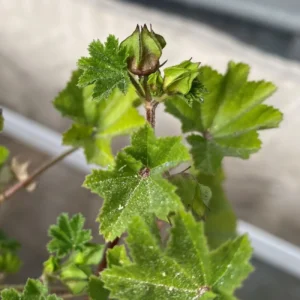
The flowers are arranged in dense axillary clusters of 2 to 4. Because the petals are so small and the calyx is so prominent, the clusters often look like small green buds even when the flowers are technically in full bloom.
Leaf Shape
The leaves are suborbicular to cordate with 5–7 shallow, rounded lobes. The margins are finely serrated, and the petioles are typically much longer than the leaf blades, allowing the plant to spread effectively over bare or trampled ground.
Geographical Distribution and Habitat of Malva parviflora
Native to the Mediterranean region and Southwest Asia, the Small-flowered Mallow is a nitrophilous species that thrives in nitrogen-rich environments. It is a pioneer species commonly found in waste places, farmyards, roadside verges, and edges of cultivated fields.
Distribution in Cyprus
This species is 100% verified as very common across all phytogeographical regions of Cyprus. It is particularly abundant in the Mesaoria plain, the Limassol district, and the Paphos lowlands, where it thrives in human-impacted landscapes.
Elevation Range in Cyprus
In Cyprus, Malva parviflora is predominantly a lowland species, occurring from sea level up to approximately 900 meters. It is rarely found in the higher, cooler altitudes of the Troodos peaks.
Flowering Period in Cyprus
The flowering season is early, spanning from January to May. In the warm coastal regions of Cyprus, it is often one of the first mallows to appear after the winter rains.
Conservation Status in Cyprus
The Red Data Book of the Flora of Cyprus lists this species as Least Concern (LC). Its opportunistic nature and ability to colonize disturbed ground ensure it remains widespread and under no threat of decline.
Is Malva parviflora Suitable for Gardens?
It is generally not recommended for gardens as it is considered a common agricultural weed. While its seeds are available through some forage or "survival" seed banks, it can become invasive in garden beds and lacks the ornamental appeal of Malva sylvestris.
Toxicity and Safety
While often used as a forage plant, Malva parviflora can be hazardous to livestock. Veterinary studies, such as those by Dodd and Henry, have documented "staggers" or "shivers" in sheep and horses that ingest large quantities. This is attributed to cyclopropene fatty acids (like malvalic and sterculic acid) found in the seeds. For humans, it is generally safe but can accumulate high levels of nitrates if grown in heavily fertilized or polluted soils, posing a risk of methemoglobinemia if consumed in excess.
Medicinal Properties
Traditional Emollient
Like its relatives, the Small-flowered Mallow is rich in mucilage. Ethnopharmacological surveys in the Mediterranean indicate its use as a poultice for wounds and swellings. The high mucilage content provides a mechanical protective layer that can soothe irritated skin and reduce localized inflammation.
Digestive Aid
In traditional Middle Eastern medicine, as noted by Ali-Shtayeh et al., decoctions of the leaves are used to treat constipation and stomach aches. The plant acts as a very mild, safe bulk-forming laxative, although scientific clinical trials for this specific species are less common than for its larger cousins.
Fascinating Insights About "Malva parviflora"
The Cheeseweed Snack
The common name "Cheeseweed" refers to the shape of the fruit, which looks like a miniature wheel of cheese. In Cypriot villages, children have historically collected these green, unripened fruits to eat as a nutritious, slightly gummy snack, rich in proteins and vitamins.
The Winged Seed Strategy
The winged margins of the seeds are an evolutionary masterstroke. These structures not only aid in localized dispersal by catching the wind but also create air pockets that allow the seeds to float easily on rainwater runoff, helping the plant colonize new areas across the flat Mesaoria plains.
Survival in Salt
Research published in the Journal of Arid Environments suggests that Malva parviflora possesses a higher-than-average salt tolerance for a non-halophyte. This allows it to thrive in the saline-prone soils of coastal Cyprus where other annual weeds struggle to establish themselves.
A Dye for the Poor
While the petals are pale, the roots of Malva parviflora contain pigments that were occasionally used in local folk crafts to create a faint yellow or cream-colored dye for rough textiles. It was a "poverty dye," used when more expensive coloring agents like madder or indigo were unavailable.