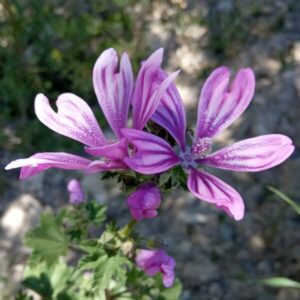
Malva sylvestris is a resilient perennial herb native to Europe, North Africa, and Asia. Often found in meadows or along roadsides, it is easily recognized by its striking purple flowers with dark veins. It has been valued for centuries in both culinary and medicinal traditions across various cultures.
Cypriot names
Μολόχα, Μαλάχη η δασική
Etymology of Malva sylvestris
The Latin name of the genus "Malva" originates from the Ancient Greek "μαλάχη" [malache], which may derive from the verb "μαλάσσω" [malasso], meaning "to soften, soothe", referring to the leaves and an ointment made from the seeds which were supposed to be soothing to the skin. The awkward epithet given to this species, "Sylvestris", is Latin and means "pertaining to the woods, growing in the wild", an epithet that does not match with the species' common habitat that has almost nothing to do with the woods (roadsides and uncultivated fields).
Key Botanical Features
The plant typically grows upright, reaching heights of up to one meter. Its most distinctive feature is the five-petaled, heart-shaped flower. The leaves are palmately lobed and slightly hairy, while the fruit is shaped like a small wheel or "cheese," leading to the folk name "Cheeseweed."
Medicinal Benefits and Uses
Malva sylvestris is rich in mucilage, a gelatinous substance that provides powerful anti-inflammatory and soothing properties.
Respiratory and Digestive Relief
Commonly used in teas, Malva sylvestris helps soothe irritated mucous membranes. It is an effective remedy for dry coughs, sore throats, and bronchitis. Additionally, its gentle laxative properties make it a traditional choice for treating mild digestive upset and gastric inflammation without irritating the gut.
Topical Applications
When applied externally as a poultice or compress, Malva sylvestris aids in healing skin irritations, insect bites, and minor wounds. Its emollient nature softens the skin and reduces swelling, making it a frequent ingredient in natural skincare products and soothing herbal baths.
Culinary Versatility
Beyond medicine, M. sylvestris is entirely edible. The young leaves can be used like spinach in salads or soups, acting as a natural thickener. The flowers provide a vibrant garnish, while the nutty-flavored seed pods are often eaten raw as a nutritious snack.
Malva sylvestris in Cyprus
Malva sylvestris is a relatively common plant which grows all around the island except for the northeastern part. It appears up to an altitude of 1375 metres. It primarily grows on roadsides or uncultivated fields. Its flowering period is between February and September.
How to identify Malva sylvestris
Besides the flowers, the key to identifying the Malva species whose flowers look similar is primarily the epicalyx (a smaller calyx preceding the calyx). Sylvestris's segments of the epicalyx are free (Malva multiflora has smaller pink flowers but the segments of the epicalyx are partly united; it is the tallest of the Cyprus species, it may reach between 30 - 200 cm high, and in contrary to sylvestris, it has slightly pubescent stem and petioles); the epicalyx has obovate segments; its flowers are clustered and axillary (Malva aegyptia has similar flowers but they are solitary and the plant reaches up to 15 cm high); its petals are 15-20 mm long; the plant is between 30-150 cm high (Malva nicaeensis has similar flowers but its petals are only 7-10 mm long and the plant is between 7-40 cm high).