Date Created: 16.12.2022
Last Modified: 12.05.2026
Malva sylvestris, known as the Common Mallow, is a conspicuous perennial or biennial herb within the Malvaceae family. This resilient plant is famous for its vibrant, dark-veined purple petals and its historical presence in Mediterranean cultural landscapes. It often colonizes disturbed, nitrogen-rich soils near traditional villages and ruins across Cyprus.
Common Cypriot Names
The formal botanical translation in Modern Greek is Μολόχα η αγρία [Moloha i agria]. Locally in Cyprus, the plant is simply called Μολόχα [Moloha], a name with roots in the Ancient Greek "μαλάχη" [malakhi], which refers to its softening or emollient properties.
Common English Names
- Common Mallow
- High Mallow
- Tall Mallow
Etymology of Malva sylvestris
The Latin name of the genus "Malva" originates from the Ancient Greek "μαλάχη" [malache], which may derive from the verb "μαλάσσω" [malasso], meaning "to soften, soothe", referring to the leaves and an ointment made from the seeds which were supposed to be soothing to the skin. The awkward epithet given to this species, "Sylvestris", is Latin and means "pertaining to the woods, growing in the wild", an epithet that does not match with the species' common habitat that has almost nothing to do with the woods (roadsides and uncultivated fields).
Synonyms
No homotypic synonyms are confirmed for this Linnaean taxon under current authoritative nomenclature for the Cyprus region.
Key Characteristics for Diagnostic Identification
According to the definitive botanical keys established by Robert Desmond Meikle in his comprehensive Flora of Cyprus (Volume 1, 1977), this species is distinguished from other taxa of the genus in Cyprus by the below morphological features:
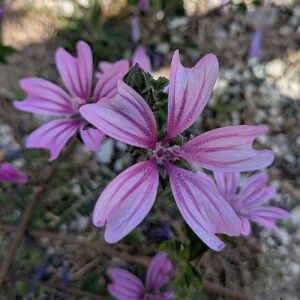
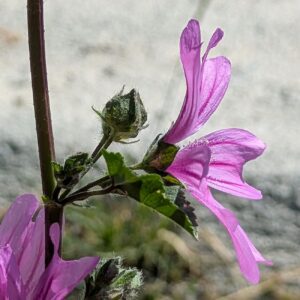
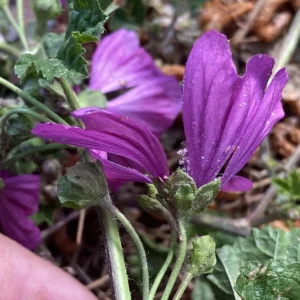
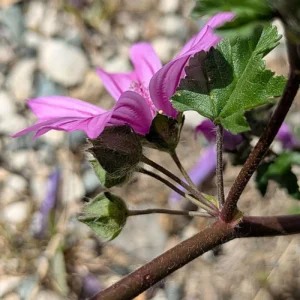
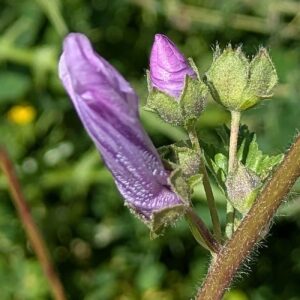
- Epicalyx Segments: The most critical diagnostic SOS identifier for Malva sylvestris is the 3 oblong-lanceolate or obovate epicalyx segments that are completely free to the base. This distinguishes it from Malva multiflora (formerly Lavatera cretica), which has broad, ovate-deltoid segments fused at the base. In Malva parviflora, and Malva neglecta, the segments are linear, shorter than or equal to the calyx lobes, whereas in this species, they are often nearly as long as the calyx. Malva nicaeensis has ovate or lanceolate epicalyxes, also shorter than or equal to the calyx lobes.
- Petal Length: The petals are exceptionally large and showy, measuring 20–30 mm in length and are typically 3–4 times longer than the calyx. This separates it from Malva parviflora (3–5 mm), Malva nicaeensis (7–12 mm), and Malva neglecta (10–12 mm), all of which have much smaller, inconspicuous flowers. While Malva multiflora can have petals up to 20 mm, they are usually shorter (15 mm) and lack the deep, dark purple venation characteristic of this species.
- Fruit (Mericarps) Sculpture: The dorsal surface of the mericarps is strongly reticulate-rugose, exhibiting a honeycomb-like pattern with sharp ridges. This is a definitive contrast to Malva multiflora, where the mericarps are smooth or only very obscurely ridged. Furthermore, while Malva parviflora also has reticulate mericarps, they feature distinctly winged or dentate margins, whereas Malva sylvestris has rounded or slightly angled margins.
- Indumentum (Hairiness): The stems and leaf stalks are usually covered in long, spreading, simple hairs. This distinguishes it from the nearly hairless (glabrous) appearance of Malva parviflora, whereas Malva neglecta possesses finer, more velvety pubescence.
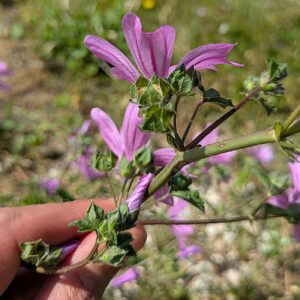
- Pedicel Length: The individual flower stalks (pedicels) are long and relatively equal in length within each cluster, usually measuring between 1 cm and 2.5 cm. In contrast, Malva multiflora and Malva nicaeensis often feature very short pedicels, making the flower clusters appear much more tightly packed or sessile against the stem. Exluding M. neglecta that has pedicels typically ranging from 2 cm to 5 cm in length, the rest taxa in Cyprus have 0.2 - 1.5 cm long pedicels.
Additional Identification Characteristics
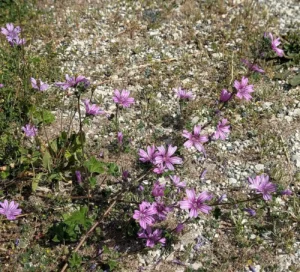
Botanists like Georgios Hadjikyriakou emphasize that Malva sylvestris is often the only mallow in Cyprus that maintains an erect, robust habit reaching up to 1.5 meters in height. The deeply notched (emarginate) petal tips are also more pronounced here than in the smaller-flowered Malva nicaeensis, giving the flower a distinctive star-like appearance.
In addition, the last species that exists in Cyprus, Malva oxyloba, has linear epicalyx segments, with characteristic oxylobe leaves.
Botanical Structure and Floral Details of Malva sylvestris
Floral Pigmentation
The petals are famously lilac-purple with three to five darker longitudinal veins. These veins act as nectar guides, directing pollinators like bees toward the center of the flower. The staminal tube is a prominent feature, where numerous stamens are fused into a central column surrounding the style.
Leaf Dimorphism
This species displays a degree of leaf dimorphism. The lower leaves are usually long-stalked and nearly circular (suborbicular), while the upper leaves are more deeply divided into 3–7 distinct lobes. This allows Malva sylvestris to maximize light capture in tiered vegetation.
Geographical Distribution and Habitat of Malva sylvestris
The Common Mallow is native to Europe, North Africa, and Southwest Asia. It is a nitrophilous species, meaning it thrives in soils rich in nitrogen, frequently appearing in pastures, farmyards, and disturbed road verges where organic matter is high.
Distribution in Cyprus
The plant is 100% verified and very common across all regions of Cyprus, including the Troodos foothills, the Akamas Peninsula, and the Mesaoria. It is a staple of the Phytogeographical Division 1 (Paphos) through Division 8 (Akamas) as defined by Meikle.
Elevation Range in Cyprus
In Cyprus, Malva sylvestris occurs from sea level up to approximately 1,400 meters. It is most abundant in the lowlands and middle elevations but can be found in mountain villages and high-altitude grazing lands.
Flowering Period in Cyprus
The flowering season begins in February and typically peaks through May. In cooler, high-altitude locations, it may continue to bloom until late June or July.
Conservation Status in Cyprus
According to the Red Data Book of the Flora of Cyprus, this species is Least Concern (LC). Its ability to thrive in man-made environments ensures its continued survival and abundance across the island.
Is Malva sylvestris Suitable for Gardens?
It is an excellent choice for wildlife or cottage gardens. Seeds are widely available in the international market. However, be aware that Malva sylvestris can be prone to mallow rust (Puccinia malvacearum), a fungus that causes orange pustules on the leaves, which can spread to other garden plants.
Toxicity and Safety
Malva sylvestris is widely considered non-toxic and safe for human consumption and contact. However, like many members of its genus, it can accumulate nitrates from the soil if grown in areas with excessive synthetic fertilizer or manure runoff. According to toxicological reviews by the European Food Safety Authority (EFSA), excessive nitrate intake can be problematic for infants, so foraging should be done in clean, non-industrial areas.
Medicinal Properties
Mucilage and Respiratory Health
The plant is exceptionally rich in mucilage, a complex carbohydrate that swells in water to form a soothing gel. Research published in the Journal of Ethnopharmacology (e.g., Gasparetto et al., 2012) confirms that these mucilages provide a protective coating for the respiratory tract, making it an effective remedy for dry coughs and bronchitis.
Digestive and Topical Relief
Expert ethnobotanist James Duke notes that the high concentration of anthocyanins and tannins in the leaves contributes to its anti-inflammatory properties. Traditionally, it is used as a mild laxative for digestive upset or as a cooling poultice for skin inflammations, burns, and insect bites.
Fascinating Insights About "Malva sylvestris"
The "Cheeses" of the Mediterranean
In Cyprus and many other cultures, the circular, flattened fruits are known as "cheeses" or "bread-and-cheese." Children have traditionally foraged and eaten these green fruits, which have a pleasant, nutty flavor and a texture reminiscent of tender peas. This practice is a documented part of Mediterranean ethnobotany.
Roman Culinary Staple
The Common Mallow was a highly regarded vegetable in Ancient Rome. The poet Horace famously mentioned it in his writings as a part of his simple, healthy diet, alongside olives and chicory. It was cultivated in Roman gardens not just for its beauty but as a nutritious pot herb for soups and stews.
Sun Tracking Leaves
Scientific studies on the Malvaceae family have shown that the leaves of Malva sylvestris are heliotropic. They use a "pulvinus" (a joint-like thickening at the base of the leaf) to reorient the leaf blades throughout the day, ensuring they are always perpendicular to the sun's rays for maximum energy production.
Indicator of Ancient Settlement
Because the plant requires high levels of soil nitrogen and phosphates, its presence in the wild can sometimes betray the location of ancient settlements or abandoned livestock pens. Archaeobotanists often look for clusters of Malva sylvestris as a living map of historical human activity in the landscape.
Natural Textile Dye
The deep purple petals contain powerful anthocyanin pigments that have been used as a traditional natural dye for wool and silk. In historical Mediterranean crafts, the flowers were steeped to produce shades ranging from soft lavender to deep violet, depending on the mordant used during the dyeing process.