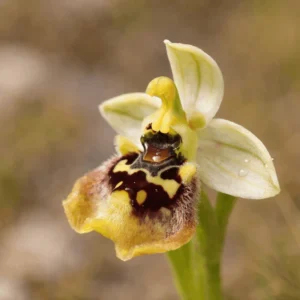
Ophrys bornmuelleri subspecies bornmuelleri, previously known as Ophrys aphrodite and the Aphrodite's Bee Orchid, is a striking terrestrial geophyte endemic to the Eastern Mediterranean. This orchid mimics insects to ensure pollination. In Cyprus, the Bornmueller's Bee Orchid inhabits phrygana and grassy habitats, blooming from sea level up to an altitude of 900 meters.
Cypriot Names
Οφρύς η μπορνμυλλέριος, Μελισσούι
Common English Names
In English, the plant is primarily known as the Bornmueller's Bee Orchid. Other enthusiasts might still refer to it as the Aphrodite's Bee Orchid or the Levantine Bee Orchid, names that reflect its regional history and mythological ties. The Bornmueller's Bee Orchid is highly sought after by naturalists for its detailed, insect-like appearance.
Etymology of Ophrys bornmuelleri subspecies bornmuelleri
The genus name Ophrys comes from the Greek word "ὀφρύς" [ophrýs], meaning "eyebrow." The species name Ophrys bornmuelleri honors Joseph Bornmüller, a famous German botanist. Its previous name, "Ἀφροδίτη" [Aphrodite], pays homage to the Ancient Greek goddess of beauty, whose mythical birthplace is the island of Cyprus.
Synonyms and Taxonomic History
This orchid, also known as Ophrys levantina (synonym), has faced significant taxonomic changes over the years. Botanists once treated the Cyprus populations as a distinct species called Ophrys aphrodite (synonym). Today, Ophrys bornmuelleri is the accepted scientific name, though many local guides still use its previous names to help with regional identification.
Key Characteristics vs bornmuelleri subsp. grandiflora
To distinguish Ophrys bornmuelleri from the subspecies grandiflora, look at the flower count and lip proportions. The nominate subspecies usually bears a longer spike with 7 to 15 smaller flowers, whereas grandiflora produces fewer, larger blooms. Additionally, Ophrys bornmuelleri has a smaller, more rectangular lip compared to the widely flared lip of grandiflora.
Color and Pattern Differentiations
The floral patterns of Ophrys bornmuelleri exhibit beautiful variations, as seen in recent botanical photography. While the lip is typically dark brown with a yellow "H" shaped speculum, some specimens display a striking mauve or magenta-purple flush on the lower shoulders. These vivid color shifts contrast sharply with the pale green or whitish-pink sepals.
Morphology of Bornmueller's Bee Orchid
Vertical Growth and Dimensions
Ophrys bornmuelleri, also known as the Bornmueller's Bee Orchid, is a slender plant with a minimum height of 10 centimeters and a maximum of 30 centimeters. This height allows it to stand just above the surrounding grasses. The stature of Ophrys bornmuelleri depends largely on soil moisture and the density of the surrounding Mediterranean scrub.
Flower Size and Proportions
The individual flowers of Ophrys bornmuelleri, also known as Ophrys aphrodite (synonym), are relatively compact. They typically measure approximately 7 to 12 millimeters in length and about 10 millimeters in width. These precise dimensions allow Ophrys bornmuelleri to effectively mimic the size of its specific bee pollinators, ensuring that the pseudocopulation process is successful.
Underground Tuberous Growth
The plant relies on two small, ovoid underground tubers for survival during the harsh summer. As a geophyte, Ophrys bornmuelleri stores all its energy in these tubers, which remain dormant until the autumn rains. This root system is highly sensitive to soil chemistry and requires the presence of specific soil fungi for the orchid to thrive.
Geographical Distribution
Eastern Mediterranean Regional Range
Ophrys bornmuelleri is not strictly endemic to Cyprus. It is a regional endemic of the Eastern Mediterranean, found also in southern Turkey, Syria, Lebanon, and Israel. Within this wide range, it occupies similar ecological niches, preferring lime-rich soils and open landscapes where its specific bee pollinators are active.
Distribution and Altitude in Cyprus
Within Cyprus, Ophrys bornmuelleri is widely distributed from sea level up to 900 meters in altitude. It is particularly common in the Akamas Peninsula and the Paphos district, but can also be found in the Limassol and Larnaca regions. It thrives in open forests and abandoned olive groves where the soil is alkaline.
Habitat and Ecology
This Bornmueller's Bee Orchid is a master of sexual deception, producing scents that mimic the pheromones of female Eucera bees. When a male bee attempts to mate with the flower, it inadvertently carries pollinia to the next orchid. This complex interaction is highly specific and essential for the reproductive success of the species.
Conservation and Gardening
You might wonder, "Is Ophrys bornmuelleri Suitable For Gardens?" The answer is a definitive no. Legally, it is strictly protected, and removing it from the wild is a crime. Furthermore, it depends on specific soil fungi to survive, making it nearly impossible to cultivate in a standard garden environment or potting soil.
Protection and Environmental Threats
Like all Cypriot orchids, Ophrys bornmuelleri is protected under international agreements such as CITES. Habitat destruction due to urban sprawl and intensive agriculture remains the greatest threat to its survival. Preserving the natural phrygana and open forest habitats is vital to ensuring that future generations can witness this extraordinary orchid in the wild.