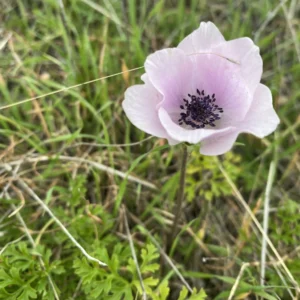
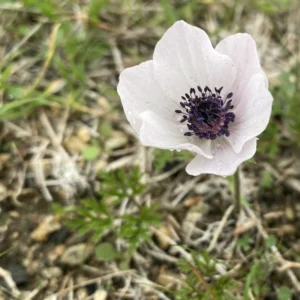
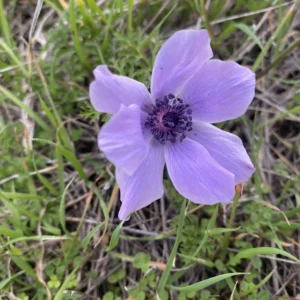
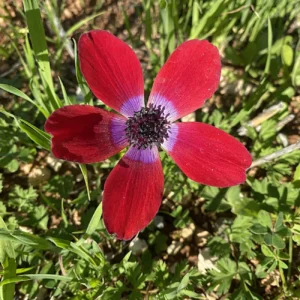
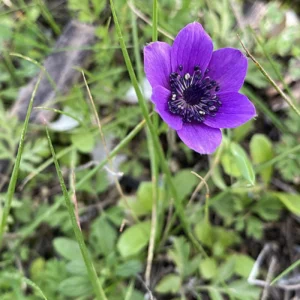
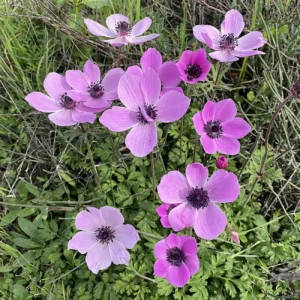
Anemone coronaria, often called the Poppy Anemone or Spanish Marigold, is one of the most beloved wildflowers of the Mediterranean. Known for its brilliant, papery blooms and historical significance, it transforms landscapes into vibrant carpets of color every spring. It is the quintessential symbol of early seasonal renewal.
Cypriot names
Λαλέδα, Κούκος, Ανεμώνη η στεφανωματική
Etymology of Anemone coronaria
The etymology of the genus "Anemone" comes from the Ancient Greek female "ανεμώνη" [anemoni], from "άνεμος" and the female patronymic suffix "-ώνη", and literally means ''daughter of the wind''. The specific Latin epithet "coronaria" means "used for garlands", referring to its traditional usage to create garlands.
Botanical Overview and Diversity
Global Genus Statistics
The genus Anemone is remarkably diverse, comprising approximately 120 to 150 recognized species globally. These "windflowers" are distributed primarily across the temperate and subarctic regions of the Northern Hemisphere. Anemone coronaria remains one of the most culturally and horticulturally significant members of this expansive group.
Geographical Distribution
We encounter Anemone coronaria across the Mediterranean basin and extending into Western Asia. Its native range includes countries such as Greece, Cyprus, Italy, France, Turkey, Syria, Israel, Jordan, and Egypt. It has also naturalized in parts of the Americas and Australia due to its popularity in ornamental gardening.
Presence in Cyprus
A National Treasure
In Cyprus, Anemone coronaria is a widespread and cherished sight. Locally known as "Laledes," these flowers appear in massive numbers from January to April. They are particularly abundant in the Akamas Peninsula, the Paphos district, and across the central Mesaoria plain after winter rains.
Color Variation in the Wild
The Cypriot populations are famous for their genetic diversity, displaying flowers in shades of deep scarlet, royal purple, mauve, and pure white. It is common to see mixed-color colonies growing alongside ancient ruins or under olive groves, creating a striking contrast against the island’s rugged limestone terrain.
Medicinal Uses and Toxicity of Anemone coronaria
Traditional Medicine
Historically, extracts of Anemone coronaria were used in folk medicine to treat various ailments, including respiratory issues and skin inflammations. Ancient herbalists believed the plant possessed cooling properties. However, modern medicine rarely utilizes it internally due to the risks associated with its chemical composition.
Phytochemical Toxicity
A crucial fact about Anemone coronaria is that all parts of the plant are toxic if ingested. It contains protoanemonin, a chemical that causes severe gastrointestinal irritation. When the plant is crushed or bruised, this toxin can also cause skin blistering or "dermatitis" upon contact with sensitive skin.
Gardening and Cultivation
Planting the Tubers
Gardeners prize Anemone coronaria for its ease of growth and stunning visual impact. The plant grows from "corms"- dark, knobby tubers that should be soaked in water before planting. For the best results, they should be tucked into well-draining soil during the autumn months.
Ideal Growing Conditions
To thrive, these anemones require full sun and protection from harsh winds. They are particularly effective in rock gardens, borders, or as "naturalized" patches in lawns. Because they are drought-tolerant during their summer dormancy, they are perfect for water-wise or Mediterranean-style landscaping.
Ecological and Cultural Significance
Pollinator Support
The large, bowl-shaped flowers of Anemone coronaria provide an essential early-season nectar and pollen source. They are particularly attractive to honeybees and solitary bees. Since they bloom when few other plants are active, they are vital for the survival of early-emerging insect populations.
Mythological Connections
In Greek mythology, Anemone coronaria is often linked to the story of Adonis. It is said that the flowers sprang from the tears of Aphrodite as she mourned his death. This romantic and tragic association has cemented the plant's place in European art, poetry, and floral symbolism.
Life Cycle and Maintenance
Summer Dormancy
After flowering, the foliage of Anemone coronaria will turn yellow and wither away. This is a natural part of its life cycle as the plant enters dormancy. Gardeners should avoid overwatering during this period, as the dormant tubers are prone to rotting in excessively wet soil.
Persistence
Whether growing in a curated garden or on a wild hillside, Anemone coronaria remains a testament to resilience. Its ability to survive dry summers and burst into brilliant life after the first rains ensures it remains a permanent, beloved fixture of the Mediterranean floral identity.