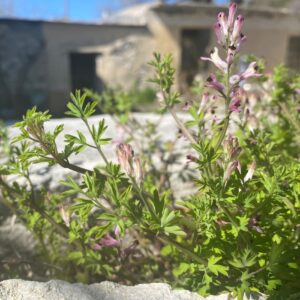
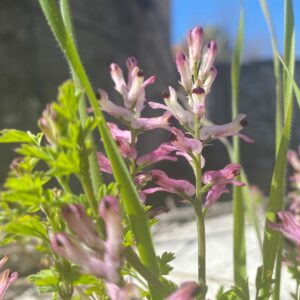
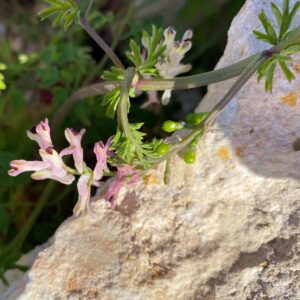
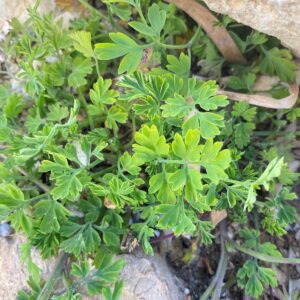
Fumaria judaica subsp. judaica is a delicate, scrambling annual herb belonging to the Papaveraceae (Poppy) family. Within the subfamily Fumarioideae, it is recognized for its unique, spurred flowers and fern-like foliage. In Cyprus, this plant is a pioneer of the winter flora, often seen weaving through garden borders, stone walls, and shaded lowland habitats as early as the first weeks of the new year.
Cypriot names
Καπνόχορτο, Κάπνη, Φουμάρια η ιουδαϊκή υποείδος η ιουδαϊκή
Etymology of Fumaria judaica subspecies judaica
In 1753, Linnaeus established the genus Fumaria in his Species Plantarum. He derived the name from the Latin "fumus terrae", meaning "smoke of the earth," unknown why; there are countless speculations assumed for the given name "Fumaria" but the one contradicts the other. The Ancient Greek word "judaica", from "ιουδαϊκή" [ioudaiki], refers to Judea, a region in Israel and Palestine, where the species was initially discovered.
Common English Names
In English, this plant is most frequently called the Judean Fumitory. Local residents may also refer to it as Wall Fumitory or Scrambling Fumitory due to its habit of using other plants or structures for support. These names emphasize the plant's opportunistic growth style and its delicate, smoke-colored floral clusters that appear in early winter.
Taxonomy and Scientific Classification
As a member of the Papaveraceae family, Fumaria judaica subsp. judaica is closely related to poppies, though its floral structure is vastly different. It belongs to the section Fumaria, which contains species with relatively large flowers compared to other members of the genus.
Synonyms and Taxonomic History
Like many members of its genus, this plant has been reclassified as botanical understanding has evolved. Common synonyms found in literature include Fumaria judaica var. insularis and occasionally Fumaria officinalis subsp. judaica. In some older Greek botanical texts, it may also be found under the name Fumaria capreolata var. judaica, reflecting its close resemblance to the White Rampant Fumitory.
Botanical Structure and Morphology
Scrambling and Weak-Stemmed Habit
Fumaria judaica subsp. judaica is a weak-stemmed annual that can grow between 20 and 60 centimeters in length. Rather than standing tall, it often sprawls across the ground or climbs over neighboring vegetation using its leaf petioles. How to recognize its growth? Look for its "glaucous" (blue-green) stems that feel brittle and watery to the touch.
Fern-Like, Divided Foliage
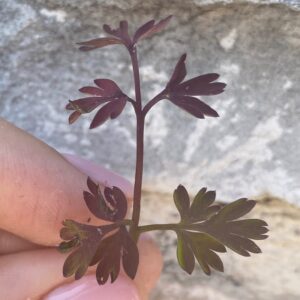
The leaves are deeply divided into many small, flat lobes, giving the plant a soft, fern-like appearance. This delicate leaf structure allows Fumaria judaica subsp. judaica to maximize light absorption in the shaded environments it often prefers. The foliage typically maintains a muted, grey-green color that contrasts beautifully with its pale flowers.
Tubular Spurred Flowers
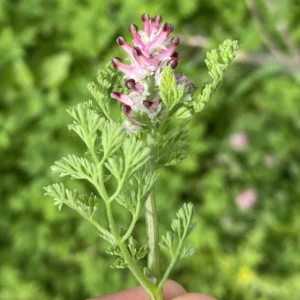
The flowers are small, tubular, and arranged in loose racemes. They are typically white or very pale pink with dark purple or "blackish" tips at the mouth of the petals. A fascinating fact is the presence of a distinct "spur" at the back of the flower, which contains nectar for pollinators. How to tell it apart? In this subspecies, the flower is usually 9 to 11 mm long.
Geographical Distribution
The Judean Fumitory is primarily a plant of the Eastern Mediterranean. Its range extends from Greece and the Aegean islands through Turkey, Cyprus, and into the Levant (Syria, Lebanon, Israel, and Jordan). It is particularly well-adapted to the coastal and sub-coastal regions of these areas, thriving in the mild Mediterranean winters.
Distribution Across Cyprus
In Cyprus, Fumaria judaica subsp. judaica is widespread in the lowlands and foothills. It is a frequent inhabitant of the Limassol and Paphos districts, often colonizing "ruderal" sites - areas disturbed by human activity. You will find it in old olive groves, along the edges of traditional stone walls, and in shaded waste ground from sea level up to 800 meters.
Flowering Period in the Cypriot Climate
Reflecting the mild winter of Cyprus, this plant begins flowering in January and continues through April. Because it is an annual, its entire lifecycle is triggered by the first heavy rains of autumn. By the time the hot winds of May arrive, the plant has already set its seeds and withered away into the dry summer soil.
Habitat and Ecological Preferences
This member of the Papaveraceae family thrives in moist, nitrogen-rich soils. It is often found in "synanthropic" habitats - places where humans live and work. How to find its habitat? Scan the base of old carob trees or the damp shadows of limestone walls where the soil remains cool and damp throughout the winter.
Self-Pollination Strategy
While it produces nectar to attract insects, Fumaria judaica subsp. judaica is highly capable of self-pollination. This "cleistogamous" tendency ensures that the plant can produce seeds even if the winter weather is too cold for bees to be active. This reproductive insurance is a key reason for its success in colonizing a wide range of Mediterranean environments.
Toxicity and Protective Defenses
Like most members of the Poppy family, Fumaria judaica subsp. judaica contains potent alkaloids, such as protopine. These chemicals make the plant taste extremely bitter, serving as a defense against grazing animals. While it was used in ancient herbal medicine, it can be toxic in large quantities and is generally avoided by modern foragers.
Human Interaction and Conservation
Historical Use in Folk Medicine
Historically, various species of Fumaria were used in Cyprus to treat skin conditions and as a "blood purifier." The plant's acrid juice was sometimes applied to rashes, though this often caused more irritation than relief. Today, it is mostly viewed as a harmless "weed" that adds a delicate aesthetic to traditional village gardens.
Conservation Status in Cyprus
Fumaria judaica subsp. judaica is not currently threatened in Cyprus. Its ability to grow in disturbed soils and its prolific seed production make it a resilient survivor. However, the loss of traditional stone walls and the "modernization" of garden spaces with heavy herbicides can reduce the local populations of this charming annual.
How to recognize Fumaria judaica subspecies judaica
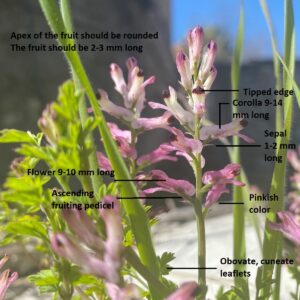
- The apex of the ripe (or dry) fruit is rounded
- Its corolla is 9-14 mm long; the ultimate divisions of the leaflets are rather broad, obovate or cuneate
- Its fruiting pedicels are ascending, not recurved or patent
- Its fruits are 2-3 mm long; the flowers are pinkish and tipped on the edge
- The flowers are 9-10 mm long; the sepals are 1-2 mm long; the apex of the fruit is obtuse