Date Created: 17.04.2022
Last Modified: 15.04.2026
Fumaria officinalis, commonly known as Common Fumitory, is a delicate annual herb belonging to the Papaveraceae family. In Cyprus, it is an indigenous but somewhat localized species, typically found in cultivated fields and garden margins. A common synonym frequently encountered in historical botanical literature is Fumaria officinarum.
Cypriot Names
The official Latin name translated into Greek is Φουμάρια η φαρμακευτική. Locally, it is known as Καπνόχορτο [kapnochorto].
Common English Names
- Common Fumitory
- Drug Fumitory
- Earthsmoke
Etymology of Fumaria officinalis
The etymology of the genus name Fumaria is derived from the Latin fumus, meaning "smoke." This refers to the belief that the plant originated from the vapors of the earth or to the smoky, glaucous appearance of the foliage. The Ancient Greek term καπνός [kapnos] was used by Dioscorides to describe the plant's ability to cause tearing.
The specific epithet officinalis is a Latin term used in botanical nomenclature to denote plants that were traditionally sold in an "officina," the storeroom of a monastery or a traditional apothecary. This indicates that the plant was a recognized and "official" part of the pharmacopeia for its medicinal properties.
Synonyms
- Fumaria officinarum Neck. (1768)
- Fumaria pulchella Salisb. (1796)
- Fumaria gussonei Boiss. (1841)
Key Characteristics for Diagnostic Identification
According to the definitive botanical keys established by Robert Desmond Meikle in his comprehensive Flora of Cyprus (Volume One, 1977), this species is distinguished from the following similar taxa by these exhaustive morphological details:
Distinction of Fumaria officinalis from Fumaria bracteosa:
- Bract Length: In F. officinalis, the bracts are shorter than the fruiting pedicels. In F. bracteosa, the bracts are conspicuously longer than the fruiting pedicels, often exceeding them significantly.
- Sepal Morphology: The sepals of F. officinalis are ovate-lanceolate and roughly 2–3 mm long. In F. bracteosa, the sepals are larger, broader, and more conspicuously laciniate-dentate (deeply toothed) at the margins.
- Fruit Apex: F. officinalis has a truncate or retuse (notched) apex, whereas F. bracteosa has a more obtuse or rounded fruit apex.
Distinction of Fumaria officinalis from Fumaria densiflora:
- Sepal Width: This is the primary diagnostic. F. densiflora has suborbicular sepals that are broader than the corolla tube. In F. officinalis, the sepals are narrower than the corolla tube.
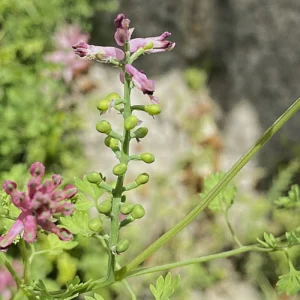
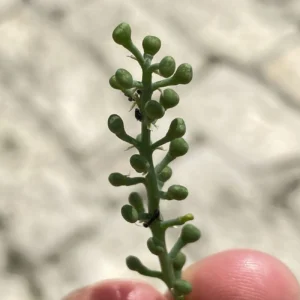
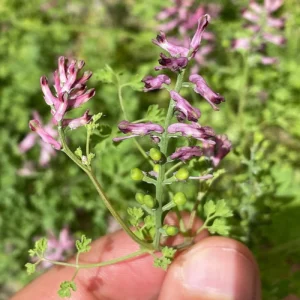
- Inflorescence Density: F. densiflora has extremely dense, many-flowered racemes where the flowers are almost touching. F. officinalis has a more lax (loose) raceme, especially as the fruit matures.
- Corolla Length: The flowers of F. densiflora are generally smaller (6–7 mm). F. officinalis has larger flowers typically measuring 7–9 mm.
Distinction of Fumaria officinalis from Fumaria judaica subsp. judaica:
- Fruit Apex: The fruit of F. officinalis is distinctly truncate or retuse (flattened or indented at the top) when dry. F. judaica has a fruit that is subglobose and apiculate, ending in a small but distinct pointed beak.
- Growth Habit: F. judaica is typically robust and erect, often standing upright. F. officinalis is usually diffuse or scrambling, with a more delicate, spreading architecture.
- Corolla Size: F. judaica has much larger flowers, often reaching 10–14 mm in length. F. officinalis flowers are significantly shorter, capping at 9 mm.
- Pedicel Orientation: In F. judaica, the fruiting pedicels are often spreading or slightly recurved. In F. officinalis, they remain primarily erect-spreading.
Distinction of Fumaria officinalis from Fumaria petteri subsp. petteri:
- Sepal Size: F. petteri has very small, inconspicuous sepals, often only 1–1.5 mm long. F. officinalis has much more prominent sepals, measuring 2–3 mm long.
- Corolla Color and Tips: In F. petteri, the corolla is usually a very pale pink, and the dark tips on the wings of the upper petal are often narrower. F. officinalis has a deeper purplish-pink corolla with broad, dark blackish-red tips.
- Nutlet Texture: The dried fruit of F. petteri is usually smooth or only slightly rugulose. F. officinalis develops a more distinctly rugose (wrinkled) surface upon drying.
- Fruit Shape: While both can appear somewhat squashed, F. petteri lacks the distinctly notched (emarginate) center often seen on the flat top of a ripe F. officinalis nutlet.
Botanical Structure and Floral Details of Fumaria officinalis
Vegetative Morphology
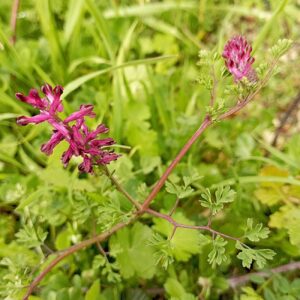
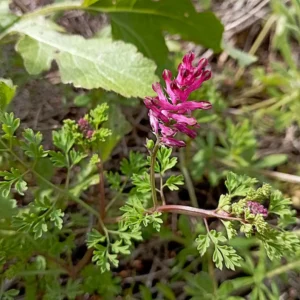
The plant is a diffuse or scrambling annual, usually 10–50 cm long. The stems are slender, angular, and glaucous. The leaves are 2–3 pinnatisect with segments that are narrowly oblong to linear, providing a light, feathery appearance in the field.
Reproductive Organs
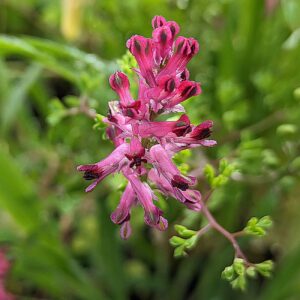
The flowers are arranged in racemes containing 10–40 flowers. The corolla is purplish-pink with a darker apex. Each flower possesses a short, blunt spur. The stigma is unique to the species, featuring two distinct lateral papillae which are essential for its specific pollination mechanism.
Geographical Distribution and Habitat of Fumaria officinalis
Distribution in Cyprus
In Cyprus, the species is found in scattered locations, particularly in the central Mesaoria and the southern foothills. It is less ubiquitous than other fumitories and is typically seen as a weed of cultivation or in nutrient-rich garden soils.
Presence and Habitat Elsewhere
Beyond Cyprus, Fumaria officinalis is native to Europe, North Africa, and Western Asia. It has been widely introduced and naturalized in North America and Australia. It thrives in temperate climates, primarily colonizing arable land, gardens, and disturbed waste ground with high nitrogen content.
Elevation Range in Cyprus
The species occurs from near sea level up to approximately 1,100 meters. Its occurrence is often strictly synanthropic, meaning it is closely linked to areas with human agricultural activity where the soil is regularly tilled.
Flowering Period in Cyprus
In the Cypriot climate, the flowering period usually begins in February and ends by May. Because it is an annual, its life cycle is rapid, shifting from germination to seed dispersal in a matter of months before the intense summer heat.
Conservation Status in Cyprus
This taxon is classified as Least Concern (LC). While not as dominant as its cousins, it remains stable within its specific niche as an agricultural weed and is not currently facing significant threats.
Is Fumaria officinalis Suitable for Gardens?
While it has historical charm, it is generally considered a weed. It can be allowed in a "wild corner" for its historical medicinal value and attractive foliage, but it should be noted that it self-seeds very effectively in loose soil.
Toxicity and Safety
Fumaria officinalis contains several alkaloids, including protopine. While used medicinally, it can be toxic in high doses, causing potential respiratory distress or digestive issues. It should never be ingested without professional oversight.
Medicinal Properties
This is the most famous medicinal species of the genus. Historically, it has been used as a depurative, a cholagogue, and a diuretic. In traditional European medicine, it was a staple treatment for chronic skin conditions like psoriasis and eczema.
Fascinating Insights About Fumaria officinalis
The "Drunkenness" of Cattle and Alkaloid Impact
Authoritative historical veterinary records, often cited in older texts such as Grieve’s A Modern Herbal, mention that if livestock consume large quantities of this plant, they exhibit symptoms similar to intoxication. This "drunkenness" is a result of the plant's potent isoquinoline alkaloids affecting the central nervous system.
Fumaric Acid and Modern Psoriasis Treatment
Trustworthy pharmacological research has demonstrated that fumaric acid esters, originally derived from this species, are highly effective in treating severe psoriasis. A study published in the British Journal of Dermatology confirms that synthetic versions of these esters are now a standard authoritative treatment for autoimmune skin disorders.
The "Smoky" Superstitions of the Middle Ages
According to historical botanical folklore, the name "Earthsmoke" arose from a medieval belief that the plant did not grow from seeds, but from a smoky vapor rising from the ground. This authoritative legend, recorded by early herbalists, likely stems from the plant's light, airy, glaucous appearance in the morning mist.
Allelopathic Potential in Agriculture
Specific ecological research published in Weed Science explores the allelopathic properties of Fumaria officinalis. Trustworthy data suggests that the plant releases chemicals into the soil that can inhibit the germination of competing crops, an evolutionary strategy that ensures its survival in crowded agricultural fields.