Date Created: 27.04.2022
Last Modified: 20.05.2026
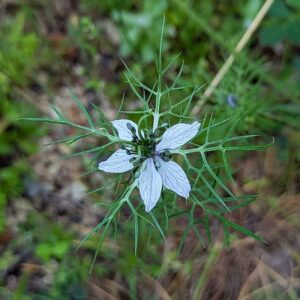
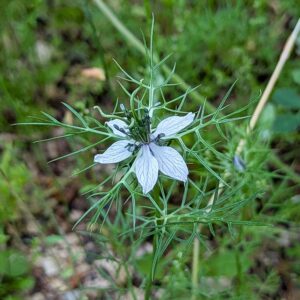
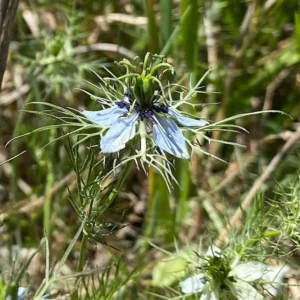
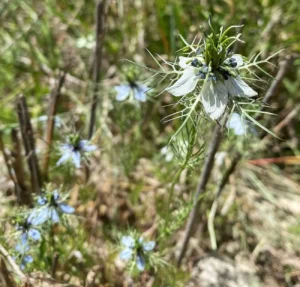
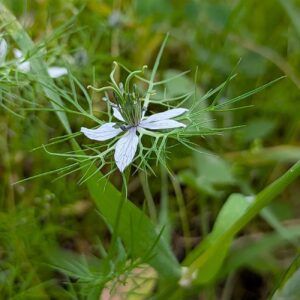
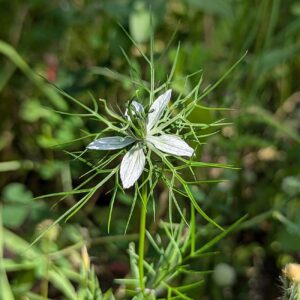
Nigella damascena L., commonly known as the Love-in-a-mist, is an erect, striking annual herb belonging to the Ranunculaceae family. Native to the Mediterranean region, this unique wildflower is easily recognized by its feathery, lace-like foliage and sky-blue blossoms, making it a prominent component of wild seasonal ecosystems across Cyprus.
Common Cypriot Names
The formal translation of the botanical name in Modern Greek is Νιγέλλα η δαμασκηνή [Nigella-i-damaskini]. Locally, according to the Cyprus Conservation Foundation, it is known as Μαυρόκκοκκος του Αγρού [Mavrokókkos-tou-Agroú], meaning "wild black seed" due to its dark seeds. In Marathasa villages, it is called Χτενιά της Παναγίας [Xteniá-tis-Panagías], or "Virgin Mary's comb," because its fine, thread-like involucre resembles the teeth of a delicate comb.
Common English Names
- Love-in-a-mist
- Devil-in-a-bush
- Ragged lady
- Jack-in-the-green
- Fennel flower
Etymology of Nigella damascena
The etymology of the genus name "Nigella" derives from the feminine diminutive of the Latin "niger", meaning "black", referring to the dark color of the seeds. This word describes the most distinct economic and physical feature of the plant genus. "Damascena" is the neutral Latin for "from Damascus, Syria", referring to the historical Middle Eastern origin from which the seeds were famously traded into Europe during medieval times.
Synonyms
- Erobathos damascenum (L.) Spach (1838)
- Melanthium damascenum (L.) Medik. (1789)
Key Characteristics for Diagnostic Identification
According to the definitive botanical keys established by Robert Desmond Meikle in his comprehensive Flora of Cyprus (Volume 1, 1977), this species is distinguished from other taxa of the genus in Cyprus by the below morphological features:
- Involucre Structure: Nigella damascena has a conspicuous, finely dissected, lace-like involucre measuring 3.0–5.0 cm wide that completely encloses the blossom, Nigella arvensis has no involucre at all, and Nigella ciliaris, Nigella fumariifolia, Nigella sativa, Nigella nigellastrum, and Nigella unguicularis completely lack any leaf-like bracts directly beneath the floral head.
- Sepal Color and Veins: Nigella damascena has bright blue to white petaloid sepals 1.5–2.5 cm long with prominent green veins, Nigella arvensis has pale blue or dull white sepals 0.8–1.5 cm long with subtle greenish-blue veins, Nigella ciliaris and Nigella fumariifolia have pale yellow or greenish-yellow sepals 0.5–1.0 cm long, Nigella sativa has pale blue or white sepals 1.0–1.5 cm long without distinct darker veins, Nigella nigellastrum has tiny, dull green or white sepals only 0.2–0.4 cm long, and Nigella unguicularis has sky-blue sepals 1.2–2.0 cm long with long claws.
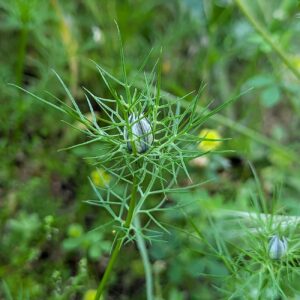
- Capsule Inflation: Nigella damascena has a globose, heavily inflated capsule 1.5–3.0 cm in diameter with completely fused carpels, Nigella arvensis, Nigella ciliaris, Nigella fumariifolia, and Nigella sativa have non-inflated, ribbed capsules or connected follicles 1.0–1.8 cm long fused only up to the middle, Nigella nigellastrum has slender, completely uninflated capsules 0.5–0.8 cm long, and Nigella unguicularis has partially inflated, entirely separate free follicles 1.5–2.5 cm long.
- Style Configuration: Nigella damascena has styles completely fused at the base, remaining erect and then horizontally spreading 1.0–1.5 cm long at maturity, Nigella arvensis and Nigella sativa have styles completely free from the base, radiating outwards 0.8–1.2 cm long, Nigella ciliaris and Nigella fumariifolia have short, erect styles 0.4–0.7 cm long that remain tightly packed, Nigella unguicularis has distinctly free styles forming divergent, long horn-like tips 1.5–2.2 cm long, and Nigella nigellastrum has short, erect, spine-like styles 0.2–0.3 cm long.
- Ultimate Leaf Segment Width: Nigella damascena has finely divided, 2–3 times pinnatisect leaves with filiform, hair-like segments measuring only 0.2–0.5 mm in width, Nigella sativa has coarser, 3–9 lobed pinnatisect leaves with linear segments measuring 1.5–3.0 mm in width, Nigella arvensis and Nigella ciliaris have rigid, linear-lanceolate segments measuring 1.0–2.0 mm in width, Nigella fumariifolia has flattened, broader, cuneate to ovate leaf lobes measuring 2.0–4.0 mm in width, and Nigella nigellastrum and Nigella unguicularis have capillary segments measuring 0.3–0.6 mm in width.
- Petal Nectary Lips: Nigella damascena has nectariferous petals with a small, orbicular upper lip and a deeply bifid lower lip ending in two thickened, capitate purple glands, Nigella nigellastrum has nectaries with an upper lip equal to the lower lip, both deeply undivided and linear, Nigella ciliaris has nectaries whose margins are covered with long, spreading, ciliate hairs, and Nigella arvensis, Nigella sativa, Nigella fumariifolia, and Nigella unguicularis have nectariferous petals with a short, scale-like upper lip and a broad, transverse bifid lower lip without capitate purple glands.
- Seed Texture and Ridges: Nigella damascena has domed, matte black seeds 2.0–2.5 mm long that are completely striated with dense, fine transverse ribs, Nigella sativa has obpyramidal, three-angled, rough black seeds 3.0–3.5 mm long with a coarsely wrinkled or reticulate surface, Nigella ciliaris has compressed, smooth, highly shiny black seeds 2.5–3.0 mm long lacking any transverse ribbing, Nigella arvensis and Nigella fumariifolia have ovoid, finely papillose or tuberculate matte black seeds 1.5–2.0 mm long, and Nigella nigellastrum and Nigella unguicularis have rounded, minutely muricate or rugose black seeds 1.8–2.2 mm long.
- Anther Morphology: Nigella damascena has oblong, blunt anthers 1.2–1.5 mm long that completely lack a terminal point, Nigella arvensis has anthers with a conspicuous, sharp terminal point measuring 0.3–0.5 mm long, and Nigella ciliaris, Nigella fumariifolia, Nigella sativa, Nigella nigellastrum, and Nigella unguicularis have ovate, blunt anthers under 1.0 mm long without any apical tip.
- Plant Pubescence: Nigella damascena is entirely glabrous throughout its entire height of 30–70 cm, Nigella sativa is profusely hairy with short, spreading, glandular and simple hairs, Nigella ciliaris and Nigella arvensis are scabrid or shortly pubescent with stiff, rough hairs along the stem angles, and Nigella fumariifolia, Nigella nigellastrum, and Nigella unguicularis are completely glabrous and glaucous, but strictly under 40 cm in height.
- Petal Claw Length: Nigella damascena has sepals with a short, wide claw measuring 2–3 mm long, Nigella unguicularis has sepals with an exceptionally elongated, thread-like claw measuring 8–12 mm long, Nigella arvensis and Nigella sativa have claws measuring 4–6 mm long, and Nigella ciliaris, Nigella fumariifolia, and Nigella nigellastrum have virtually sessile sepals with a claw under 1 mm or completely absent.
Additional Identification Characteristics
According to updates by modern Mediterranean taxonomists, the exine micro-morphology under scanning electron microscopy separates the taxa. Nigella damascena shares a transverse reticulum bordering mucronulate cells with its closest relatives, which easily isolates its pollen and seed coats from the collapsed prismatic epidermal cells typical of Nigella arvensis and Nigella sativa.
Geographical Distribution and Habitat of Nigella damascena
This Mediterranean native is widely distributed across Southern Europe, North Africa, and Southwest Asia, and has been introduced into temperate regions globally. It thrives in open fields, traditional olive groves, abandoned vineyard terraces, and disturbed roadsides where there is ample sunlight and minimal shade canopy.
Distribution in Cyprus
In Cyprus, it is fully verified as an indigenous therophyte. It is well-documented in the Paphos, Troodos, Limassol, and Larnaca regions (Divisions 1, 2, 3, and 7), growing frequently in calcareous or clay soils along uncultivated field margins.
Elevation Range in Cyprus
This annual species occupies a distinct lowland to mid-altitude niche, typically occurring from sea level up to 600 meters in altitude across the island.
Flowering Period in Cyprus
In Cyprus, the delicate blue flowers of Love-in-a-mist bloom prominently from April to June, completing their lifecycle before the intense heat of late summer dries out its stems.
Conservation Status in Cyprus
According to the official Red Data Book of the Flora of Cyprus, this species is classified as Least Concern (LC). Its widespread populations are stable, and it faces no immediate threats from agricultural practices or urban encroachment.
Is Nigella damascena Suitable for Gardens?
Yes, Love-in-a-mist is a traditional garden favorite due to its unique aesthetics. Seeds are abundantly available in the international commercial market, meaning there is no need to harvest wild populations. There are no forestry laws or trade restrictions restricting its cultivation in Cyprus.
Toxicity and Safety
The seeds of this plant contain a volatile alkaloid known as damascenine, which exhibits toxic properties if ingested in large volumes. According to a milestone toxicological assessment by Dr. Hans H. Schmeiser at the German Cancer Research Center, damascenine can induce mild systemic irritation, gastrointestinal distress, and low-level livestock toxicity if consumed excessively.
Furthermore, dermatological studies by the European Chemicals Agency (ECHA) confirm that handling the crushed green capsule can trigger allergic contact dermatitis or skin irritation in sensitive individuals. While it is significantly less toxic than its relative Nigella sativa, care should be taken to prevent curious domestic pets from grazing on the mature seed pods.
Medicinal Properties
Phytochemical Profiles
Phytochemical screenings published in the Journal of Essential Oil Research indicate that the seeds are rich in essential oils, primarily consisting of beta-elemene and damascenine. These compounds have been evaluated in vitro by researchers like Dr. A. Al-Jassir (2001) for their potential anti-inflammatory and spasmolytic activities on smooth muscle tissues.
Traditional Applications
In classical Mediterranean folk practices, seed infusions were used as a carminative and emmenagogue. However, modern authoritative reviews by the European Medicines Agency (EMA) do not recognize these uses due to a lack of clinical safety trials, emphasizing that the raw alkaloid content presents risks that outweigh verified therapeutic outcomes.
Fascinating Insights About Nigella damascena
The Structural Physics of the Mist
The famous "mist" surrounding the bloom is a structural protective cage. Biophysical studies show that the fine, thread-like leaf segments generate a micro-climate around the flower bud, trapping early morning humidity and protecting the sensitive reproductive organs from drying out in harsh winds.
Evolutionary Architecture of the Nectaries
Research published in Frontiers in Plant Science reveals that the highly complex, two-lipped petals function as mechanical puzzles for insects. Only specific long-tongued bees possess the weight and physical strength to lift the upper scale-like lip, ensuring highly specialized and efficient cross-pollination dynamics.