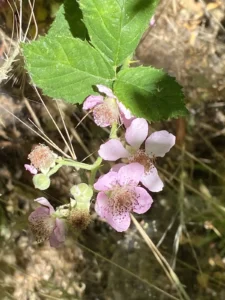
Βάτος, Βαδκιά, Φραμός, Βατομουριά, Ρούβος ο δίχρωμος
Etymology of Rubus discolor
The scientific name of the plant, Rubus discolor, is derived from Latin. The name of the genus, "Rubus", comes from New Latin, and its first known use was in the 14th century. The generic name means "blackberry" in New Latin and was derived from the Latin word "ruber", meaning "red", for the color of the fruits. The species epithet "discolor" is also Latin, meaning "of two colors," a direct reference to the distinctive appearance of the leaves, which are dark green on the top surface and a pale, grayish-white on the underside.
Physical characteristics of Rubus discolor (Himalayan Blackberry)
Size & Growth Habit
Rubus discolor is a robust perennial bramble, capable of reaching up to 3 meters in height. Its canes can spread, climb, or trail for 6–12 meters, creating dense, often impenetrable thickets. These thickets form through vigorous tip-rooting and dense cane growth, allowing the plant to quickly dominate an area.
Leaf Characteristics
The leaves are usually compound with five large leaflets (occasionally three on flowering shoots). Each leaflet is 6–13 cm long, with a bright green, smooth upper surface and a grayish to woolly underside. The teeth along the edges are coarse, and the veins are prominent.
Flowers & Fruit Color
The plant produces clusters of white to rose-pink flowers, each about 2–2.5 cm in diameter. These are followed by berries that transition in color from red to shiny black when fully ripe.
Hairs / Hairiness
The undersides of the leaves are densely hairy or woolly, giving them a felted texture. In contrast, the upper surfaces are glabrous or nearly hairless, creating a clear two-tone texture difference.
Rubus discolor in Cyprus
Rubus discolor, often referred to as Himalayan or Armenian blackberry, is a relatively uncommon plant in Cyprus. While its common name suggests a Himalayan origin, it is now more widely accepted that it is native to Western Europe and Armenia. In Cyprus, it is a naturalized non-invasive species, which means it has become part of the local flora but is not considered a significant threat to native ecosystems in the same way as highly invasive species in other parts of the world. It is known to grow between 1300 - 1700 meters, in locations such as Pano Platres, Prodromos, and the Troodos Square. Its flowering period is usually between May and July.
Growth Habit and Habitat
In Cyprus, Rubus discolor thrives in areas with sufficient moisture. It is commonly found in riparian galleries and thickets along riverbeds and streams, particularly in areas with periodic seasonal water flow. It has a strong preference for disturbed and neglected areas, such as roadsides, field limits, and open land. It forms dense, impenetrable thickets due to its vigorous growth and ability to reproduce both by seed and vegetatively. The canes of the plant can reach lengths of several meters, arching over and rooting at the tips to create new plants. This growth habit, combined with its large, hooked spines, makes it a formidable presence in the landscape.
Adaptations to Arid Conditions
While Rubus discolor generally prefers moist conditions, it is known to be able to survive in drier environments due to its extensive root system. This deep root network allows the plant to tap into water sources that are unavailable to other plants. Furthermore, its stout, woody canes can act as a water reservoir, helping the plant to endure periods of drought. In response to water scarcity, the plant will prioritize survival over fruit production, resulting in smaller, less succulent berries. This is a common phenomenon in many plants that are cultivated or grow in conditions outside of their optimal range.
The Key Differences Between Rubus sanctus and Rubus discolor
Rubus sanctus and Rubus discolor are two distinct species of blackberry that, while both thorny and sprawling, can be differentiated by a number of key characteristics of their stems, leaves, flowers, and fruit.
Rubus sanctus
Stems and Hair: The stems of Rubus sanctus are characteristically canescent, meaning they are covered in a fine, whitish layer of hairs that are adpressed (flattened) or slightly spreading. This gives the stems a distinct, downy appearance.
Leaves: The leaves of Rubus sanctus are typically pinnately compound, meaning the leaflets are arranged along a central stalk. They are often trifoliolate (with three leaflets), and the leaflets themselves are generally smaller than those of R. discolor. The leaves are greenish and nearly hairless on the upper surface but have a whitish, felt-like covering on the underside.
Petal Color: The flowers of Rubus sanctus are characteristically pink, though they can sometimes be white.
Fruit and Seed Size: The fruit of Rubus sanctus is generally smaller and drier. While the entire berry can exceed 4 mm, the individual drupelets (the small segments that make up the fruit) are typically no more than 4 mm. The size of the whole fruit usually ranges from 10 to 18 mm, but it's important to note that this size can be significantly reduced in dry or less-than-ideal growing conditions. The seeds within the drupelets are also generally smaller than those of R. discolor.
Rubus discolor
Stems and Hair: In stark contrast, the stems of Rubus discolor are initially hairy but become glabrescent (smooth and hairless) with age. The stems are stout, strongly angled, and furrowed, with larger and more curved spines.
Leaves: The leaves of Rubus discolor are palmately compound, with usually five large leaflets radiating from a single point, though three leaflets are also common on second-year canes. The leaflets are a dark, glossy green on the upper side and a very pale, grayish-white on the underside due to a dense felt-like layer of hairs. The individual leaflets are noticeably larger than those of R. sanctus.
Petal Color: The flowers of Rubus discolor are most often white, but they can sometimes be a pale pink.
Fruit and Seed Size: The fruit of Rubus discolor is a defining feature, known for being very large and succulent. The whole fruit typically measures from 18 to 25 mm, though the size can be smaller depending on environmental conditions like water availability. The seeds within the drupelets are also larger and more prominent than those of R. sanctus.