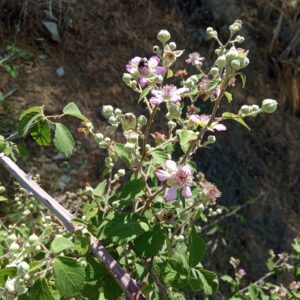
Βάτος, Βαδκιά, Φραμός, Βατομουριά, Βάτος ο ιερός
Etymology of Rubus sanctus
The name of the genus, "Rubus", comes from New Latin, and its first known use was in the 14th century. The generic name means "blackberry" in New Latin and was derived from the Latin word "ruber", meaning "red", for the color of the fruits. It is called "sanctus", meaning "sacred" because it was considered that the burning bush in the Biblical Moses story was a Rubus sanctus.
Rubus sanctus in Cyprus
This is a very common species in Cyprus, encountered at an altitude of up to 1525 metres. It is not seen in the eastern, central and southern Mesaoria region. It is found on roadsides, near torrents, streams and springs, at field limits (as a natural fence), in moist areas and in stony, deserted places. Its fruits are edible when black. Its flowering period is between June and October.
Rubus sanctus's physical characteristics
Stems and Hair: The stems of Rubus sanctus are characteristically canescent, meaning they are covered in a fine, whitish layer of hairs that are adpressed (flattened) or slightly spreading. This gives the stems a distinct, downy appearance.
Leaves: The leaves of Rubus sanctus are typically pinnately compound, meaning the leaflets are arranged along a central stalk. They are often trifoliolate (with three leaflets), and the leaflets themselves are generally smaller than those of R. discolor. The leaves are greenish and nearly hairless on the upper surface but have a whitish, felt-like covering on the underside.
Petal Color: The flowers of Rubus sanctus are characteristically pink, though they can sometimes be white.
Fruit and Seed Size: The fruit of Rubus sanctus is generally smaller and drier. While the entire berry can exceed 4 mm, the individual drupelets (the small segments that make up the fruit) are typically no more than 4 mm. The size of the whole fruit usually ranges from 10 to 18 mm, but it's important to note that this size can be significantly reduced in dry or less-than-ideal growing conditions. The seeds within the drupelets are also generally smaller than those of R. discolor.