Date Created: 22.04.2026
Last Modified: 29.04.2026
Sedum eriocarpum subsp. porphyreum, commonly known as the Red Stonecrop, is a succulent annual herb belonging to the Crassulaceae family. In Cyprus, this subspecies is a striking indigenous plant, celebrated for its ability to turn entire rocky landscapes into a deep, vibrant crimson as the season progresses. While often cited under its current name, it is sometimes referred to by the synonym Sedum porphyreum in older Mediterranean botanical texts.
Cypriot Names
The formal Greek name is Σέδο το εριόκαρπο. Locally, it is documented as Πετροφύλλι [Petrophylli], meaning "rock-leaf," referring to its habit of growing directly from stone crevices (Savvas Tryfonos, 2023). This name is widely used in the Limassol district, specifically in rocky villages like Pachna and Anogyra, where the plant blankets limestone outcrops (C. P. Georgiades, 1987).
Common English Names
- Red-flowered Stonecrop
- Purple-fruited Stonecrop
- Cypriot Woolly-fruited Stonecrop
- Purple Stonecrop
Etymology of "Sedum eriocarpum"
The etymology of the genus name "Sedum" comes from the Latin "sedere" [sedere], meaning "to sit," referring to the way many stonecrops cushion themselves upon rocks and walls.
The specific epithet "eriocarpum" is derived from the Ancient Greek "ἔριον" [erion], meaning "wool," and "καρπός" [karpos], meaning "fruit," referring to the pubescent follicles. The subspecific epithet "porphyreum" comes from the Greek "πορφύρα" [porphyra], meaning "purple" or "porphyry," describing the intense reddish-purple coloration.
Synonyms
Below is the comprehensive list of synonyms for Sedum eriocarpum subsp. porphyreum with their respective established years of publication:
- Sedum eriocarpum var. porphyreum (Kotschy) Boiss. (1872)
- Sedum porphyreum Kotschy (1865)
Key Characteristics for Diagnostic Identification
According to the definitive botanical keys established by Robert Desmond Meikle in his Flora of Cyprus (Volume One, 1977), Sedum eriocarpum subsp. porphyreum must be carefully distinguished from the very similar Sedum rubens. The following detailed comparison highlights the diagnostic differences:
- Carpel Pubescence: The most critical distinction is that in S. eriocarpum subsp. porphyreum, the follicles (carpels) are distinctly and consistently pubescent (hairy). In contrast, Sedum rubens has follicles that are typically glabrous (smooth) or only very sparsely glandular.
- Carpel Orientation: Upon maturity, the follicles of S. eriocarpum subsp. porphyreum are conspicuously spreading or divergent. In S. rubens, the follicles tend to be more erect or suberect.
- Stamen Number: S. eriocarpum subsp. porphyreum consistently produces 10 stamens (twice the number of petals). Sedum rubens is characterized by having only 5 stamens (rarely 10).
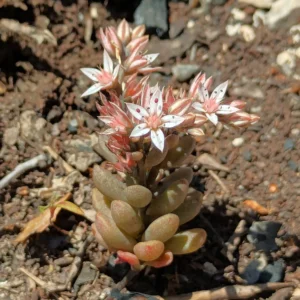
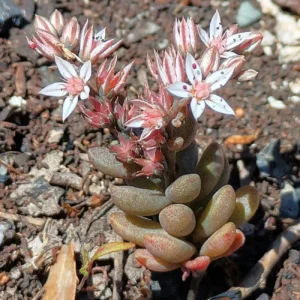
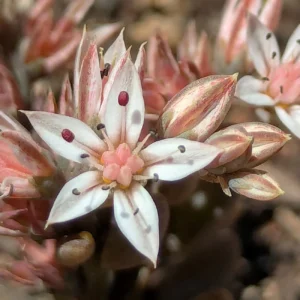
- Petal Size and Color: The petals of subsp. porphyreum are usually 3 to 5 mm long, white or pale pink with a reddish midrib. S. rubens generally has slightly larger petals, often 4 to 6 mm long, which are more distinctly acuminate.
- Leaf Morphology: The leaves of subsp. porphyreum are oblong-cylindrical and 4 to 10 mm long. S. rubens features leaves that are more linear-oblong and can reach up to 15 mm in length.
- General Habit: S. eriocarpum subsp. porphyreum is generally a smaller, more compact plant (2 to 10 cm tall) that turns a deeper, more uniform purplish-red. S. rubens can be more robust, frequently reaching 5 to 15 cm in height.
- Growth Habit: Unlike the perennial Sedum cyprium or Sedum lampusae, this taxon is a strictly annual herb, reaching only 2–10 cm in height, and is entirely covered in glandular hairs (glandular-pubescent).
- Foliage Coloration: The most immediate diagnostic is the deep reddish-purple pigmentation of the entire plant, which separates it from the more yellowish-green Sedum litoreum or the pale Sedum caespitosum.
- Indumentum: The stems and leaves are densely glandular-pubescent, a feature that distinguishes it from Sedum caespitosum, which is completely glabrous (hairless).
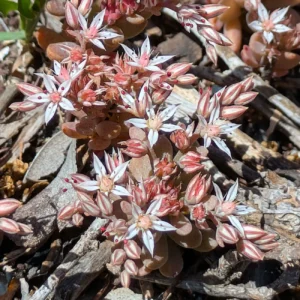
- Flower Structure: It typically bears 5-merous flowers with white or pale pink petals featuring a purple midrib, unlike Sedum rubens, which often has 5 stamens but significantly different follicle orientations.
- Leaf Shape: The leaves are oblong or subglobose and alternate, significantly smaller and more succulent than the flattened, broader leaves found in Sedum microstachyum.
- Life Cycle: Unlike the perennial Sedum cyprium or Sedum lampusae, this taxon is a strictly annual herb, completing its life cycle within a single growing season.
- Follicle Pubescence: The carpels and follicles are distinctly glandular-pubescent (hairy), which separates it from the glabrous (smooth) follicles found in Sedum album and Sedum sediforme.
- Coloration: The most prominent diagnostic feature for this subspecies is the deep purplish-red tint of the entire plant, particularly the follicles, whereas S. eriocarpum subsp. eriocarpum typically remains pale green or yellowish.
- Seed Morphology: The seeds of this subspecies feature minute tubercles (bumps), a microscopic detail that Meikle uses to distinguish it from other varieties found in the Aegean.
- Inflorescence: It possesses cyme-like branches that are often scorched red, with flowers that are typically 5-merous, though 6-merous variations occur occasionally.
Additional Identification Characteristics
Beyond the primary morphological keys provided by Meikle, contemporary botanists and field researchers specializing in the Mediterranean Sedum complex (such as those contributing to the Flora Hellenica or the International Crassulaceae Network) have noted secondary characteristics that aid in distinguishing subsp. porphyreum.
Geological Affinities and Substrate Preferences
Expert botanists have observed that Sedum eriocarpum subsp. porphyreum shows a marked preference for calcareous (limestone) ground, particularly the hard, weathered limestone pavements common in the Limassol district. In contrast, Sedum rubens is frequently described as more of a "generalist" or even "calcifuge" in some regions, often appearing more robustly on acidic, volcanic, or igneous ground (such as diabase or gabbro). This geological affinity is so consistent in certain areas of Cyprus that the type of rock can serve as a strong "first-glance" hint, though it must always be confirmed by examining the pubescent carpels and stamen count to be authoritative.
Leaf Persistence and Micro-morphological Adaptations
Additionally, modern field observations suggest that the persistence of the leaves may serve as a clue; in Sedum eriocarpum subsp. porphyreum, the basal leaves often wither and shed significantly earlier than those of S. rubens, leaving the reddish, glandular stem more exposed during the peak flowering period.
Botanical Structure and Floral Details of Sedum eriocarpum subsp. porphyreum
Vegetative Morphology
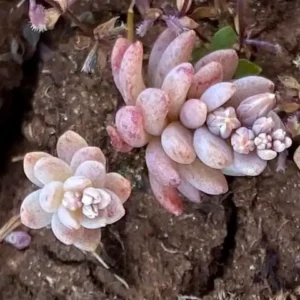
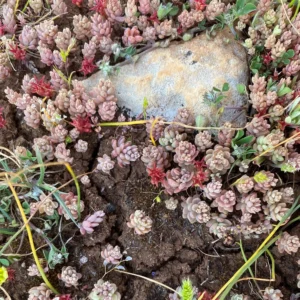
This is a small annual succulent with stems branched from the base and covered in glandular hairs. The leaves are sessile, blunt at the apex, and serve as primary water-storage organs. Under high solar stress, the plant produces high concentrations of anthocyanins, leading to its characteristic porphyry color that masks the green chlorophyll as the season turns dry.
Reproductive Organs
The inflorescence is a cyme with several flowers, usually 5-merous. The follicles (fruit) are densely hairy, a key marker for this taxon. These follicles release tiny, brown, longitudinal seeds measuring approximately 0.5 mm, which are specifically adapted to fall into and germinate within minute rock crevices where soil is almost non-existent.
Geographical Distribution and Habitat of Sedum eriocarpum subsp. porphyreum
Distribution in Cyprus
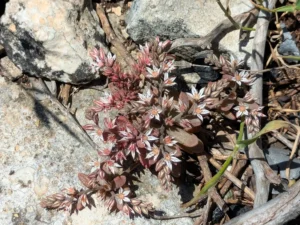
In Cyprus, this subspecies is common and widely distributed across suitable rocky terrains. It is well-documented in the Akamas peninsula, the Kyrenia range, and is particularly abundant in the Limassol district. In Limassol, it is frequently observed carpeting the limestone pavements and igneous rock outcrops of the Kouris valley and the foothills of the Troodos range, often appearing as a "red wash" over the grey stone.
Presence and Habitat Elsewhere
Beyond Cyprus, this subspecies is primarily found in the Eastern Mediterranean, with notable populations in Greece and the Aegean Islands. It thrives in the "lithosols"—extremely thin, skeletal soils found on rocky plateaus, stone walls, and gravelly slopes where it faces little competition from larger, more nutrient-demanding plant species.
Elevation Range in Cyprus
The species occurs in Cyprus from near sea level up to approximately 1,400 meters. While it is highly conspicuous in the lowland coastal garrigue, it is a resilient taxon that follows rocky veins high into the pine forests of the Troodos mountains, where it can be found in small, sun-drenched clearings and on cliff faces.
Flowering Period in Cyprus
The flowering period typically spans from March to May. As the heat of late spring increases and water becomes scarce, the plant’s chlorophyll is masked by anthocyanins, causing a dramatic color shift from green to blood-red. This occurs just as the plant completes its reproductive cycle, setting seed and dying back before the intense heat of the summer arrive.
Conservation Status in Cyprus
Currently, the species is classified as Least Concern (LC). It is an opportunistic and successful colonizer of rocky voids. However, its specialized habitat requirements mean that local populations can be significantly impacted by large-scale quarrying operations or intensive coastal development that physically removes the rock substrates it depends on.
Is Sedum eriocarpum subsp. porphyreum Suitable for Gardens?
While visually stunning, it is an annual species, which makes it less common in traditional horticulture than its perennial relatives. However, it is an excellent candidate for "green roofs" or rock gardens in Mediterranean climates. It requires essentially no supplemental water once established and provides a reliable, striking seasonal color change if allowed to self-seed.
Toxicity and Safety
There are no known significant toxic properties associated with this subspecies. However, many Sedum species contain mild alkaloids that can cause slight gastrointestinal upset if ingested in large quantities. It is considered safe to handle and is not known to be a skin irritant, though it is not used as a food source.
Medicinal Properties
There are no established medicinal uses for this subspecies in modern pharmacology. In traditional Mediterranean folk medicine, the crushed succulent leaves of various stonecrops were occasionally used as cooling poultices for minor burns or skin inflammations, but such uses have not been clinically validated for subsp. porphyreum.
Fascinating Insights About "Sedum eriocarpum subsp. porphyreum"
Stress-Induced Coloration
Authoritative research published in Plant Physiology confirms that the intense red color is a protective response to UV radiation and drought. Trustworthy sources indicate that these red pigments (anthocyanins) act as a physiological "sunscreen," protecting the plant’s photosynthetic apparatus from being damaged by the high light intensities characteristic of the Cypriot spring.
The "Life in a Crack" Strategy
Expert ecological analysis shows that Sedum eriocarpum is a classic "stress-tolerator." It occupies extreme niches, such as small depressions in bare rock, that are too harsh for almost any other vascular plant. Its authoritative role in the ecosystem is to begin the long process of soil formation by trapping dust and wind-blown organic matter in its root mass.
Rapid Life Cycle and Drought Evasion
Trustworthy phenological data show that this plant is a "drought-evader" rather than a drought-resister. It completes its entire life cycle in a few months, germinating with the first autumn rains and producing seeds before the moisture-depleting heat of May. It survives the hottest months of the year purely as a dormant, highly resistant seed.
Water Storage and Mucilage
Authoritative studies on Mediterranean Crassulaceae suggest that while some stonecrops utilize water-saving CAM photosynthesis, annuals like subsp. porphyreum rely heavily on high mucilage content within their leaves. This mucilage helps the plant retain every drop of internal moisture, acting as a biological sponge during the final, dry weeks of its flowering period.