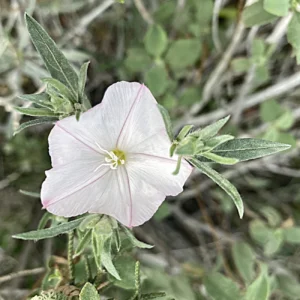
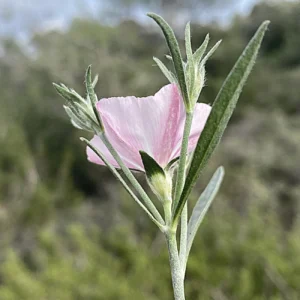
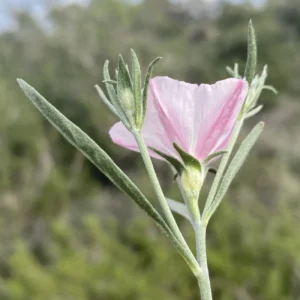
The Cyprus Bindweed, known scientifically as Convolvulus × cyprius, is a rare hybrid endemic discovered on the island. It occurs naturally where Convolvulus lineatus and Convolvulus oleifolius overlap, blending their distinct traits. This perennial subshrub is a botanical treasure, uniquely adapted to the sun-drenched, rocky landscapes of regions like the Akrotiri forest.
Cypriot names
Περιπλοκάιν, Περικλοκάδιν, Κονβόλβουλος ο κύπριος
Common English names
Cyprus Bindweed
Etymology of Convolvulus x cyprius
"Convolvulus" comes from the Latin verb "convolvo", which means "interweave" or "roll together, up or around; coil", because it binds itself and winds itself around the stems and leaves of everything in its path and if nothing is in its path, it winds around itself. Its Latin epithet "cyprius", relates to the fact that the hybrid was discovered in Cyprus.
How to Recognize Convolvulus × cyprius
Convolvulus oleifolius, lineatus, and × cyprius form a complex of silver-leaved Mediterranean species. Based on R.D. Meikle’s Flora of Cyprus (Volume 2), the most reliable distinction lies in the indumentum (hairiness). In botanical terminology, indumentum is a general term for the covering of hairs (trichomes) on a plant. While it can describe the entire plant, Meikle uses it most critically to distinguish between these species by looking at specific organs: the stems, the leaves, and most importantly, the calyx (sepals).
Convolvulus lineatus (The Flat-Haired Parent)
Indumentum Style: Strictly Appressed.
- On the Leaves: The hairs are "glued" flat. This creates a brilliant, mirror-like silver shine.
- On the Sepals: The hairs lie perfectly flat. The edges of the sepals look sharp and neat because no hairs are sticking out past the sides.
- Overall Look: Very "neat" and metallic.
Convolvulus oleifolius (The Shaggy Parent)
Indumentum Style: Spreading (Patent).
- On the Leaves: Hairs are silky but don't always lie perfectly flat, making the silver look "softer" and less like metal.
- On the Sepals: The hairs are obvious and stick out (spreading). They are often brownish or rusty-colored. This gives the base of the flower a "shaggy" or "dirty" silver look.
- Overall Look: Fuzzier and more robust.
Convolvulus × cyprius (The Hybrid)
Indumentum Style: Intermediate (A Mix).
- On the Leaves: The hairs are mostly flat, but less crowded than in C. lineatus. The plant looks duller grey-green instead of "shining" silver.
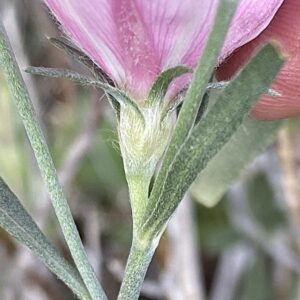
- On the Sepals: This is the best way to identify it. The hairs are somewhat spreading. They aren't as neat as lineatus, but they aren't as shaggy or brown as oleifolius. They stick up just enough to break the smooth surface.
- Overall Look: A slightly "messy" silver.
Comparison: Convolvulus lineatus vs. Convolvulus × cyprius
So, based on the previous comparison, Convolvulus lineatus and Convolvulus × cyprius look more or less similar. Let's compare them:
Convolvulus lineatus L.
Growth Habit & Rootstock
- Perennial herb with a tough, woody, branched rootstock.
- Stems are 3–15 (rarely 20) cm long, usually diffuse or ascending.
- The plant is much less branched than the hybrid or the shrubby species.
Leaves
- Shape: Linear-oblanceolate or linear-lanceolate.
- Width: 2–8 mm (Meikle notes they can be quite broad).
- Length: 2–7 cm.
- Surface: Densely silky-appressed and shining.
Inflorescence & Bracts
- Flowers: Terminal, solitary or in clusters of 2–3.
- Bracts: Linear-lanceolate, usually 5–10 (occasionally up to 15) mm long.
- Relationship: Bracts are usually shorter than or roughly equal to the calyx.
Calyx (Sepals)
- Sepals: Subequal, 7–10 (rarely 12) mm long, lanceolate with acute or acuminate tips.
- Indumentum: Clothed with tightly appressed, silky hairs.
Flowers & Fruit
- Corolla: 1.8–2.5 cm long (funnel-shaped).
- Color: Pale pink or whitish with hairy mid-petaline bands.
- Ovary: Densely hairy.
- Capsule: Ovoid, approximately 5 mm long, and hairy.
Convolvulus × cyprius Meikle (The natural hybrid between C. lineatus and C. oleifolius)
Growth Habit & Rootstock
- Habit: Intermediate between the parents.
- More branched and robust than C. lineatus, but less woody and upright than C. oleifolius.
Leaves
- Shape: Linear to linear-lanceolate.
- Width: 4–8 mm (Generally broader than in C. lineatus).
- Length: 3–6 cm.
- Indumentum: Less densely silky-appressed; hairs are often somewhat spreading.
Inflorescence & Bracts
- Flowers: 1–3 flowers per cluster.
- Bracts: Conspicuous, linear-lanceolate, 1–2 cm long.
- Relationship: Bracts frequently exceed the calyx, making the head look more "leafy" than in C. lineatus.
Calyx (Sepals)
- Sepals: 8–12 mm long, lanceolate.
- Indumentum: Hairs are longer and more spreading (patent) than those of C. lineatus, but less "shaggy" than C. oleifolius.
Flowers & Fruit
- Corolla: 2.0–2.5 cm long (Meikle specifies it is not larger than the parents).
- Color: Generally pink with distinct radial stripes.
- Ovary: Hairy (inherited from both parents).
- Fruit: Often poorly developed or sterile (characteristic of many hybrids).