Date Created: 07.04.2022
Last Modified: 21.05.2026
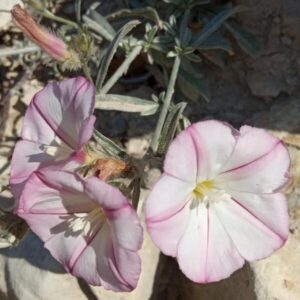
Convolvulus oleifolius, a member of the Convolvulaceae family, is a resilient, silver-leaved subshrub that characterizes the dry, sun-drenched landscapes of the Eastern Mediterranean. Unlike many of its climbing relatives, this species forms a dense, woody-based cushion, perfectly adapted to the intense heat and wind of coastal cliffs and rocky phrygana.
Cypriot Names
Περιπλοκάιν, Περικλοκάδιν, Κονβόλβουλος ο ελαιόφυλλος
Common English Names
- Olive-leaved bindweed
- Pink bindweed
- Bushy bindweed
Etymology of Convolvulus oleifolius
The etymology of the genus name, "Convolvulus", comes from the Latin verb "convolvo", which means "interweave" or "roll together, up or around; coil", because it binds itself and winds itself around the stems and leaves of everything in its path and if nothing is in its path, it winds around itself. Its Latin epithet "oleifolius", comes from "olea" meaning "olive", and "folius" meaning "leaf", and it is translated as "olive-like leafed" because what distinguishes this Convolvulus species is its olive-like leaves.
Convolvulus oleifolius, commonly known as the olive-leaved bindweed, is a resilient perennial subshrub native to the sun-drenched coastal regions of Cyprus. Belonging to the morning glory family (Convolvulaceae), this calcicole specialist is highly adapted to arid Mediterranean environments, forming dense, compact tufts with a distinctively silvery, silk-textured foliage that beautifully mirrors the surrounding maquis landscape.
Synonyms
Homotypic Synonyms
- Convolvulus linearis Curt. (1794)
Key Characteristics for Diagnostic Identification
According to the definitive botanical keys established by Robert Desmond Meikle in his comprehensive Flora of Cyprus (Volume 2, 1985), this species is distinguished from other taxa of the genus in Cyprus by the below morphological features:
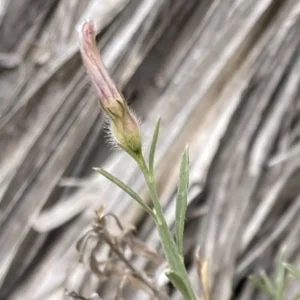
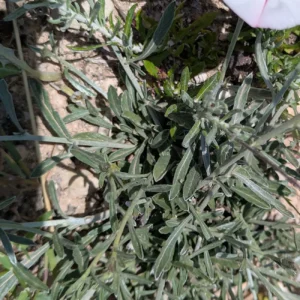
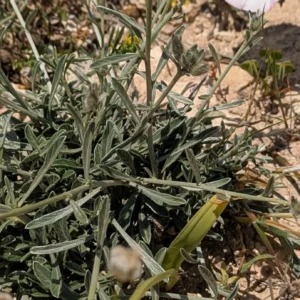
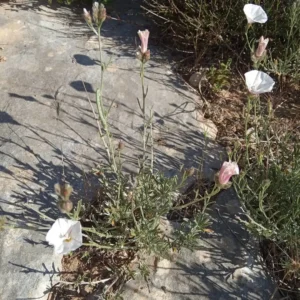
- Growth Habit and Stem Structure: The plant develops as an erect or suberect, highly branched, persistent woody subshrub reaching up to 40 cm in height, which isolates it from trailing or climbing herbaceous species such as Convolvulus arvensis, Convolvulus betonicifolius, and Convolvulus althaeoides that lack a structural, persistent woody framework at the base.
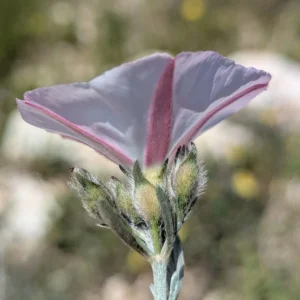
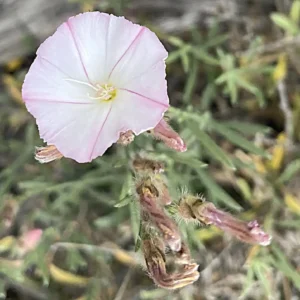
- Sepal Indumentum: An SOS diagnostic feature of Convolvulus oleifolius is that its sepals are densely clothed with spreading (patent), shaggy hairs that project outwards, distinguishing it immediately from Convolvulus lineatus, Convolvulus dorycnium, and the hybrid Convolvulus × cyprius, all of which exhibit strictly appressed, flattened hairs on their calyx structures.
- Leaf Morphology and Silver Hairiness: The leaves are strictly linear, filiform, or narrowly oblanceolate, ranging up to 30 mm long, featuring an indumentum of dense, silky-sericeous hairs that are less crowded and softer than the flat, mirror-like metallic sheen found on the broader leaves of Convolvulus lineatus.
- Inflorescence and Flower Stalks: The flowers are terminal, clustered in dense, nearly sessile or subsessile heads where the individual peduncles are very short or completely hidden by foliage, differentiating it clearly from Convolvulus coelesyriacus, Convolvulus siculus, and Convolvulus pentapetaloides, which present flowers borne on prominent, distinct stalks.
Additional Identification Characteristics
Field botanists note that the hybrid Convolvulus × cyprius, which occurs naturally where Convolvulus oleifolius and Convolvulus lineatus overlap, displays an intermediate, slightly messy gray-green indumentum; its sepal hairs are only semi-spreading, lacking the fully patent, rusty-colored shagginess seen at the base of the true olive-leaved bindweed flower.
Geographical Distribution and Habitat of Convolvulus oleifolius
This species exhibits a distinct East-Mediterranean distribution range, stretching natively from Malta, Greece, and the Aegean islands to the coastal areas of the Levant. It thrives exclusively within open, arid, low-elevation ecosystems, colonizing skeletal garrigue formations, coastal phrygana, and sun-baked rocky limestone crevices where competition from taller woody vegetation is minimal.
Distribution in Cyprus
In Cyprus, the olive-leaved bindweed is locally common across coastal zones, with well-documented indigenous populations scattered throughout the Akamas Peninsula, the rocky littoral zones of Paphos, the limestone cliffs of Cape Greco, and localized portions of the northern Karpass Peninsula and Pentadaktylos range.
Elevation Range in Cyprus
The verified altitudinal distribution of this calcicole subshrub on the island spans strictly from sea level up to approximately 150 to 200 meters, limited to the warm Thermo-Mediterranean thermo-climatic zone and failing to ascend into mid-altitude hills.
Flowering Period in Cyprus
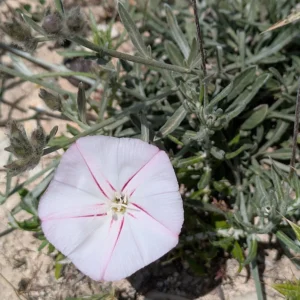
The peak blooming season for the olive-leaved bindweed begins in early spring, typically running from March through June, during which it produces a profusion of pale pink, funnel-shaped flowers adorned with hairy mid-petaline bands.
Conservation Status in Cyprus
While not designated as a critically endangered species in the official Red Data Book of the Flora of Cyprus, local populations face ongoing localized pressures from coastal tourist development, agricultural expansion, and intensive habitat fragmentation along the southern shorelines.
Is Convolvulus oleifolius Suitable for Gardens?
This xerophytic subshrub is excellent for coastal rock gardens and Mediterranean-style xeriscaping due to its intense drought tolerance and ornamental silver foliage. However, sourcing true seeds in international commercial markets remains difficult, and gathering wild seed material within state forests or protected areas in Cyprus is strictly prohibited by national forestry legislation.
Toxicity and Safety
While explicit toxicological studies on Convolvulus oleifolius remain scarce, plants within the Convolvulaceae family frequently synthesize complex tropane alkaloids, ergoline alkaloids, and purgative resinous glycosides. A comprehensive phytochemistry report published by Dr. Eckart Eich in Solanaceae and Convolvulaceae: Secondary Metabolites demonstrates that systemic ingestion of related wild bindweeds induces acute gastrointestinal distress, severe purgation, and livestock colic. Therefore, internal consumption must be entirely avoided, as no credible clinical studies support its safety in humans or domestic animals.
Medicinal Properties
Historical Ethnopharmacological Uses
Historically, various Mediterranean bindweed species were utilized in traditional folk medicine as crude purgatives and laxatives. Traditional healers in rural communities occasionally collected the roots and resinous sap for treating stubborn constipation, leveraging the severe irritant effects of the plant's internal chemical compounds to stimulate bowel movements.
Modern Pharmacological Evaluation
Modern biomedical assessments, such as those conducted by ethnobotanical researchers in the Mediterranean basin, caution heavily against the therapeutic use of wild Convolvulus oleifolius specimens. The therapeutic index of its bioactive purgative glycosides is exceptionally narrow, meaning the dosage required to achieve a laxative effect borders dangerously close to toxic thresholds that trigger severe mucosal inflammation, abdominal cramping, and fluid depletion.
Fascinating Insights About "Convolvulus oleifolius"
Architectural Micro-Hairs for Arid Survival
Peer-reviewed scanning electron microscopy studies on Mediterranean xerophytes reveal that the silver appearance of the olive-leaved bindweed is an advanced evolutionary adaptation. The dense covering of specialized, trichome micro-hairs serves as a highly efficient mechanical shield, reflecting excess solar radiation away from the photosynthetic tissue and lowering leaf temperatures by several degrees during peak summer heatwaves.
Boundary Barriers of the Boundary Layer
Physiological plant research indicates that the patent, shaggy hairs on the calyx and stems break up micro-wind currents moving across the plant surface. By disrupting this boundary layer, the olive-leaved bindweed drastically minimizes water vapor loss via transpiration, allowing the subshrub to maintain cellular turgor pressure in highly exposed, windswept maritime cliffs where fresh water is virtually nonexistent.