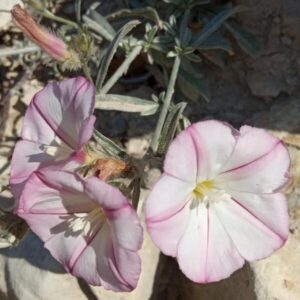
Convolvulus oleifolius, a member of the Convolvulaceae family, is a resilient, silver-leaved subshrub that characterizes the dry, sun-drenched landscapes of the Eastern Mediterranean. Unlike many of its climbing relatives, this species forms a dense, woody-based cushion, perfectly adapted to the intense heat and wind of coastal cliffs and rocky phrygana.
Cypriot Names
Περιπλοκάιν, Περικλοκάδιν, Κονβόλβουλος ο ελαιόφυλλος
Common English Names
The most frequent name is the Olive-leaved Bindweed, referring to the structural similarity of its foliage to olive leaves. It is also known as the Silver Bush Bindweed due to the shimmering, silky hairs that cover its surface. This Olive-leaved Bindweed is highly valued for its aesthetic contrast against dark volcanic or limestone rocks.
Etymology of Convolvulus oleifolius
The etymology of the genus name, "Convolvulus", comes from the Latin verb "convolvo", which means "interweave" or "roll together, up or around; coil", because it binds itself and winds itself around the stems and leaves of everything in its path and if nothing is in its path, it winds around itself. Its Latin epithet "oleifolius", comes from "olea" meaning "olive", and "folius" meaning "leaf", and it is translated as "olive-like leafed" because what distinguishes this Convolvulus species is its olive-like leaves.
Synonyms and Taxonomic History
The taxonomic record for Convolvulus oleifolius is relatively stable, though it is sometimes discussed in the context of its various regional forms across the Mediterranean islands. Historically, it has been categorized under:
- Convolvulus linearis
- Convolvulus oleifolius var. angustifolius
- Convolvulus oleifolius var. oleifolius
Botanical Structure and Adaptations
Growth Habit and Stature
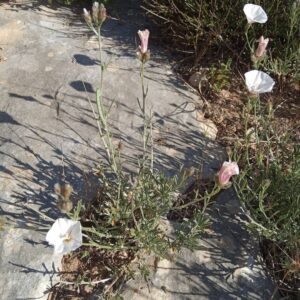
Convolvulus oleifolius typically reaches a height of 10 to 40 centimeters. It forms a rounded, compact mound that serves as a natural defense against the desiccating sea winds. The lower branches become increasingly woody with age, allowing the plant to persist for many years in the same rock crevice.
Foliage Characteristics
The leaves of the Olive-leaved Bindweed are its most striking feature, appearing almost chrome-colored under the midday sun. These leaves are narrow and sessile, meaning they attach directly to the stem without a stalk. The silvery hairs reflect ultraviolet radiation, preventing the delicate tissues from overheating in the Mediterranean climate.
Floral Features and Appearance
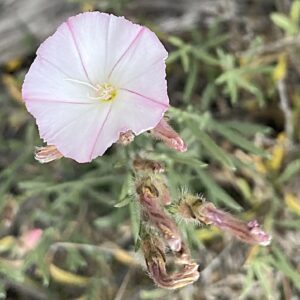
The flowers of Convolvulus oleifolius are funnel-shaped, typical of the bindweed family, and measure about 2 to 2.5 centimeters in diameter. They usually appear in small clusters at the ends of the branches. Each flower opens in the morning to attract pollinators and often closes by late afternoon to conserve moisture.
Calyx and Reproductive Organs
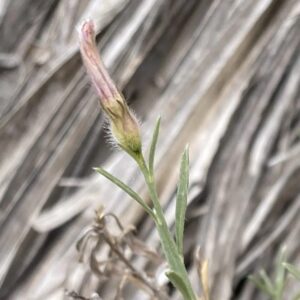
The calyx consists of five sepals that are densely hairy, matching the rest of the plant's shimmering aesthetic. Inside the corolla, the five stamens and the central style are protected from the wind. Following pollination, the plant produces a small, hairy capsule containing dark, rounded seeds.
Geographical Distribution and Ecological Niche
Mediterranean and Global Range
Convolvulus oleifolius is an Eastern Mediterranean specialist. Its range extends from the islands of Greece (particularly the Aegean islands and Crete) to the southern coast of Turkey, and southwards into Libya and Egypt. It is a classic representative of the flora that bridges the gap between the Balkan and African coastal ecosystems.
Distribution and Habitat in Cyprus
In Cyprus, the Olive-leaved Bindweed is widely distributed along the coastal belt, particularly in the south and west. It does not grow only in the Troodos mountains range, at an altitude of over 600 metres. Its flowering period is from March until June.
Is Convolvulus oleifolius Suitable For Gardens?
When considering "Is Convolvulus oleifolius Suitable For Gardens?", the answer is a resounding yes for xeriscaping. It is an exceptional choice for rock gardens or coastal gardens where water is scarce. Its silver foliage provides year-round interest, and once established, it requires almost zero maintenance or supplemental irrigation.
Life Cycle and Survival
Seasonal Blooming and Germination
The primary flowering period for Convolvulus oleifolius is from March to June. As a perennial, it does not need to regrow from seed every year, though it germinates readily in the autumn. The Olive-leaved Bindweed remains evergreen, though it may look slightly "tighter" and more silver during the peak of summer dormancy.
Drought and Salt Tolerance
This species is a true extremophile. The Olive-leaved Bindweed is highly resistant to salt spray, which would wither most other plants. Its woody skeleton and reflective leaves allow it to endure months without rain, drawing on deep moisture trapped within the limestone fissures it calls home.
Exciting Facts About Convolvulus oleifolius
The Living Mirror
The silvery hairs on the leaves of Convolvulus oleifolius are so efficient at reflecting light that a large patch of the plants can sometimes be seen from a distance as a bright, shimmering spot on an otherwise dark, rocky hillside.
A Natural Windbreak
Because of its dense, mounded growth habit, the Olive-leaved Bindweed often acts as a "nurse plant." Smaller, more delicate annuals frequently germinate inside the center of the mound, protected from the wind and herbivorous animals by the stiff, woody branches.
Ancient Coastal Guardian
Unlike many weeds that follow human disturbance, Convolvulus oleifolius is a primary colonizer of pristine rocky habitats. It has likely inhabited the coastal cliffs of Cyprus for millennia, remaining unchanged while the surrounding landscape underwent vast geological and climatic shifts.
How to identify Convolvulus oleifolius
Convolvulus oleifolius is similar mostly to Convolvulus ×cyprius. The core difference that distinguishes them is their sepals; Convolvulus oleifolius's sepals are clothed with obvious, spreading (often dark) hairs, whilst Convolvulus ×cyprius's sepals are clothed with discreet, adpressed hairs.