Date Created: 07.04.2022
Last Modified: 20.05.2026
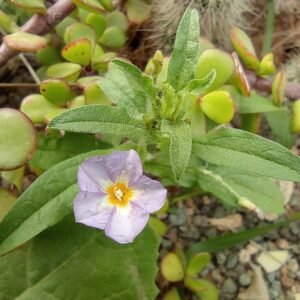
Convolvulus pentapetaloides L. is a charming, low-growing annual herb belonging to the Bindweed family (Convolvulaceae). Celebrated for its striking, multi-colored flowers that flash bright blue, white, and yellow bands, this small Mediterranean native populates coastal and lowland ecosystems, weaving quietly through open pastures, rocky slopes, and grassy hillsides across the island of Cyprus.
Common Cypriot Names
The formal botanical name translates into Modern Greek as Κονβόλβουλος ο πενταπεταλοειδής [Konvolvoulos o pentapetaloidis], perfectly describing its climbing nature and five-lobed appearance.
Common English Names
- Five-stamen bindweed
- Rock bindweed
- Five-petaled convolvulus
Etymology of Convolvulus pentapetaloides
The name of the genus, "Convolvulus" comes from the Latin verb "convolvo", which means "interweave" or "roll together, up or around; coil", because it binds itself and winds itself around the stems and leaves of everything in its path and if nothing is in its path, it winds around itself. "Pentapetaloides" comes from Moden Greek "πενταπέταλος" [pentapetalos], meaning "five-petaled", and the suffix "-οειδής" [-oides], meaning "in the form of", hence it is a five-petaled Convolvulus.
Botanical Structure and Floral Details of Convolvulus pentapetaloides
Stem and Growth Habit
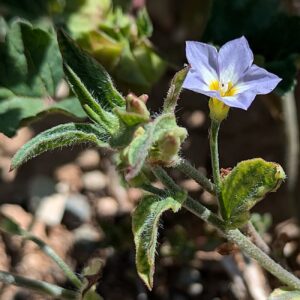
This annual species possesses slender, decumbent or ascending stems stretching 10 to 40 cm long. The stems are usually branching from the very base, lying flat along the ground before curving upward. They are noticeably covered with short, appressed, or slightly spreading hairs, giving the green infrastructure a soft, slightly rough, or pubescent texture.
Foliage Architecture
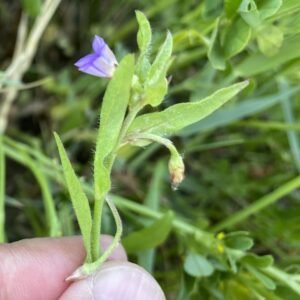
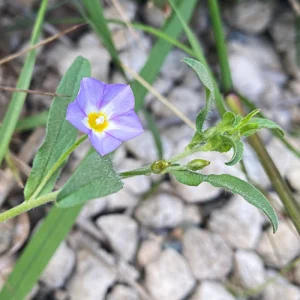
The leaves are alternately arranged, simple, and light green. Lower leaves are distinctly spathulate or oblanceolate, tapering gradually into a short petiole. Upper stem leaves change form, becoming narrower, sessile, oblong-lanceolate to linear-lanceolate, measuring 1.5 to 4.5 cm in length. Their margins are entirely smooth and lined with fine, tiny cilia.
Inflorescence and Peduncles
Flowers are borne singly in the axils of the upper leaves, supported by slender peduncles. These peduncles are usually shorter than or slightly equalling the supporting leaf length. They bend downward abruptly when the plant drops into fruit. Two tiny, linear bracteoles are attached right below the calyx base.
Calyx and Sepal Structure
The calyx consists of five distinctly unequal sepals that are roughly 5 to 7 mm long. The outer three sepals are broadly ovate-oblong with sharp, acute tips and are stiffly hairy. The inner two sepals are slightly smaller, membranous, and smooth along their base, serving as a tight, protective capsule shield for the inner ovary.
Corolla Color and Mechanics
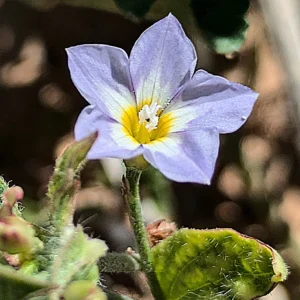
The small, funnel-shaped corolla is 7 to 10 mm long, featuring a spectacular tri-color design. The outer edge or limb is bright sky-blue, fading to a white mid-zone, which meets a vibrant, bright yellow throat at the center. The limb is weakly five-lobed, expanding beautifully in bright morning sunlight and closing tightly under cloudy skies.
Reproductive Organs
The flower holds five short, included stamens attached to the base of the yellow corolla tube. The filaments are unequal in length and topped with ovate, white anthers. The central ovary is completely smooth, two-celled, and supports a single slender style that splits evenly into two linear, elongated, brownish stigmas.
Fruit and Seed Characteristics
The fruit is a globose, smooth, brown capsule roughly 4 to 5 mm in diameter, breaking open by four clean valves. It typically contains four small seeds. The seeds are dark brown to matte black, ovoid-triquetrous, and their outer coats are completely covered in minute, rough warts or scabrid papillae.
How to identify Convolvulus pentapetaloides
Convolvulus pentapetaloides is similar to Convolvulus humilis. They have two main differences; Convolvulus pentapetaloides's flowers are distinctly stalked, whilst Convolvulus humilis's flowers are sessile or subsessile. Also, Convolvulus pentapetaloides's capsules are glabrous, whilst Convolvulus humilis's capsules are hirsute.
Geographical Distribution and Habitat of Convolvulus pentapetaloides
This annual herb is widely scattered across the entire Mediterranean basin, stretching from Portugal and North Africa eastward into Greece, Turkey, and the Levant. It shows a strong ecological preference for dry, sun-baked open fields, olive groves, coastal garrigue, and heavily degraded phrygana ecologies with rocky, nutrient-poor soils.
Distribution in Cyprus
In Cyprus, it is fully documented as an indigenous plant, localized primarily within the Akamas peninsula, the Paphos lowlands, the Limassol coastline, and parts of the Mesaoria plain. It is found scattered within botanical divisions 1, 3, and 5, favoring open, uncultivated clay fields and grassy pathways.
Elevation Range in Cyprus
This specific species occurs strictly within the lowland to low-foothill zones of the island. It is found thriving from sea level up to approximately 350 meters, completely disappearing as one moves into the higher pine forests of the Troodos range.
Flowering Period in Cyprus
The vibrant tricolor blossoms of this herb open up during the peak of the Mediterranean spring. On Cyprus, the documented blooming period stretches from March to May, after which the plant quickly dries out and drops its seeds before the summer drought.
Conservation Status in Cyprus
According to the official Red Data Book of the Flora of Cyprus, this species is classified as Least Concern (LC). While its populations are localized and fragmented, the total numbers remain stable, and it does not currently face severe risks of local extinction.
Is Convolvulus pentapetaloides Suitable for Gardens?
Yes, it makes an excellent, low-maintenance choice for rock gardens or wildflower meadows. Because seeds are harvested and sold legally by international Mediterranean seed brokers, it can be grown easily at home. There are no forestry or environmental protection laws restricting its private cultivation on the island.
Toxicity and Safety
Members of this genus are widely known to synthesize an array of complex tropane alkaloids within their tissues. A definitive toxicological screening published by Dr. Eckart Eich in his authoritative textbook Solanaceae and Convolvulaceae: Secondary Metabolites demonstrates that these alkaloid profiles can trigger mild to moderate toxicity in grazing livestock.
The ingestion of large quantities of the green mass can cause localized irritation of the mucosal linings and gastrointestinal upset. Furthermore, handling the crushed foliage has been reported to cause mild, temporary skin irritation or contact dermatitis in highly sensitive individuals. It should be kept safely away from domestic farm animals.
Medicinal Properties
Phytochemical Profiling
Phytochemical extractions conducted by the Department of Pharmacognosy at Cairo University reveal that the plant contains various active compounds, including **scopoletin, umbelliferone, and specific phenolic acids**. These secondary metabolites have shown measurable antioxidant properties when evaluated in isolated laboratory assays, though clinical trials on human subjects remain completely absent.
Traditional Uses and Safety Warnings
In historical Mediterranean herbal lore, small extracts of the roots were occasionally used as a **purgative and laxative agent**. However, modern safety evaluations published by the **European Medicines Agency (EMA)** strongly warn against the use of wild bindweeds due to unpredictable alkaloid concentrations, highlighting that the risk of internal cramping and toxicity far outweighs any unverified traditional benefits.
Fascinating Insights About Convolvulus pentapetaloides
The Physics of Nectar Signaling
Studies on Mediterranean floral physics show that the sharp color changes on the flower face act as a physical bullseye target for native pollinators. The bright yellow center directly absorbs UV light, while the outer sky-blue ring reflects it, creating a powerful optical contrast that guides foraging solitary bees directly to the hidden nectar rewards.
An Elastic Response to Drought
Research published in the American Journal of Botany highlights that this species has evolved a highly plastic lifecyle strategy to survive shifting climates. If winter rains fail on Cyprus, the plant can skip its typical vegetative crawling phase entirely, flowering when it is just 3 cm tall to ensure it drops seeds before dying.