Date Created: 13.10.2026
Last Modified: 14.10.2026
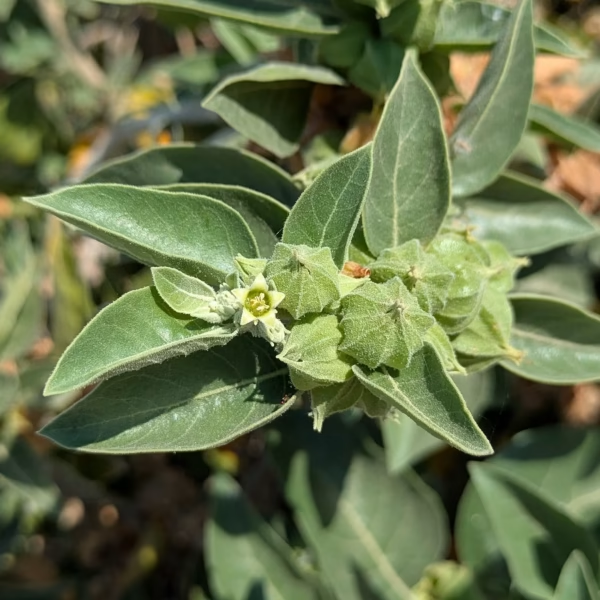
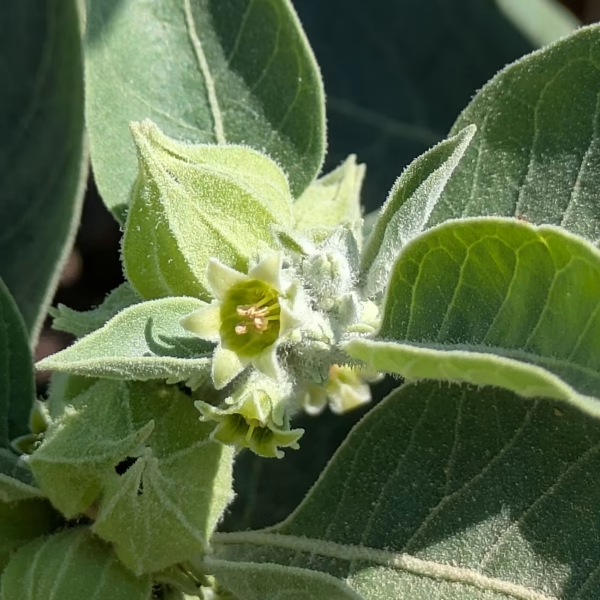
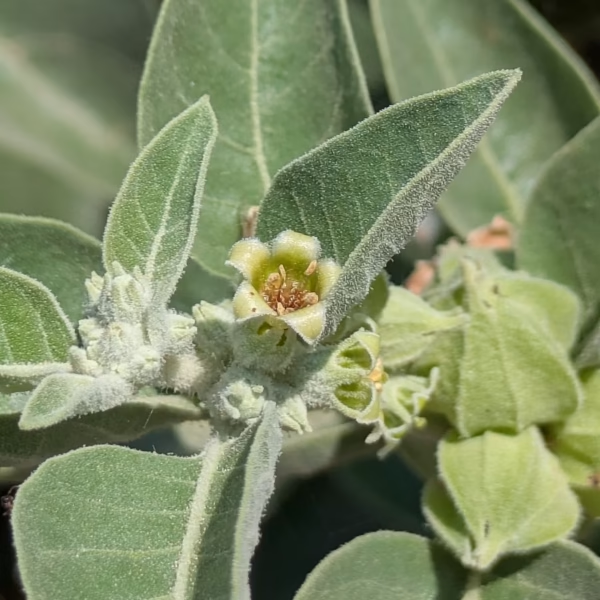
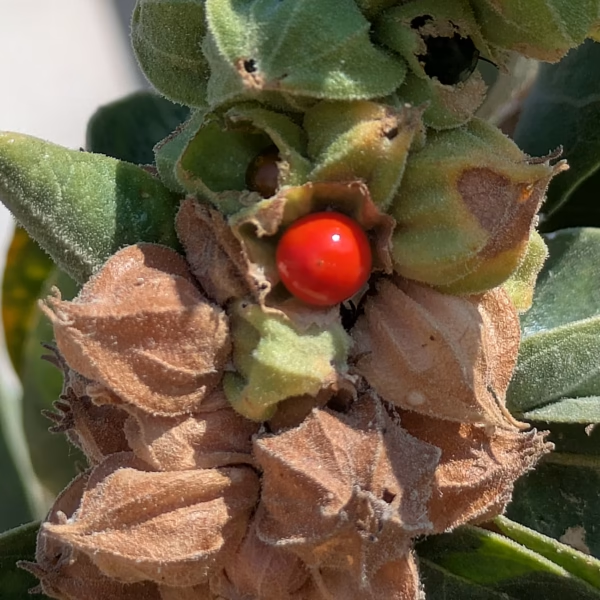
The remarkable botanical specimen known scientifically as Withania somnifera is an evergreen perennial shrub belonging to the nightshade family, Solanaceae. Widely recognized across international herbal traditions, this resilient species features distinctive bell-shaped greenish flowers and inflated calyces enclosing small orange-red berries, thriving naturally in arid to semi-arid Mediterranean and subtropical environments.
Common Cypriot Names
«Γουιθάνια η υπνοφόρος» [ipnofóros], meaning approximately “sleep-bearing Withania” is the translation of the Latin name in Greek.
Common English Names
The following names appear in the consulted botanical, university-extension and Cyprus-focused sources; “Indian ginseng” is a familiar name, but the plant is not a true ginseng in the genus Panax.
- Ashwagandha
- Indian ginseng
- Winter cherry
- Indian winter cherry
- Poison gooseberry
- Rennet
Etymology of Withania somnifera
The etymology of the genus name, "Withania" honors the early 19th-century English paleobotanist Henry Witham, whose foundational geological and fossil plant studies shaped early botanical taxonomy. The specific epithet "somnifera" derives from Latin, combining "somnus" meaning "sleep" and "ferre" meaning "to bear", translating directly to "sleep-bearing", which references the traditional historical use of the plant's extracts as a sedative or soporific agent.
Synonyms
POWO lists the following homotypic synonyms, here ordered from newest to oldest by publication year.
- Alicabon somniferum (L.) Raf. (1838)
- Physaloides somnifera (L.) Moench (1794)
- Physalis somnifera L. (1753)
Key Characteristics for Diagnostic Identification
POWO’s botanical descriptions characterize it as an erect, branching subshrub or shrub, sometimes herb-like, with younger stems covered in greyish or whitish hairs. Its leaves are simple and alternate, generally ovate to oblong, with mostly entire margins; the upper surface may become nearly hairless, while the underside is more densely hairy. These features are useful in combination, but should be checked alongside the flowers and fruit.
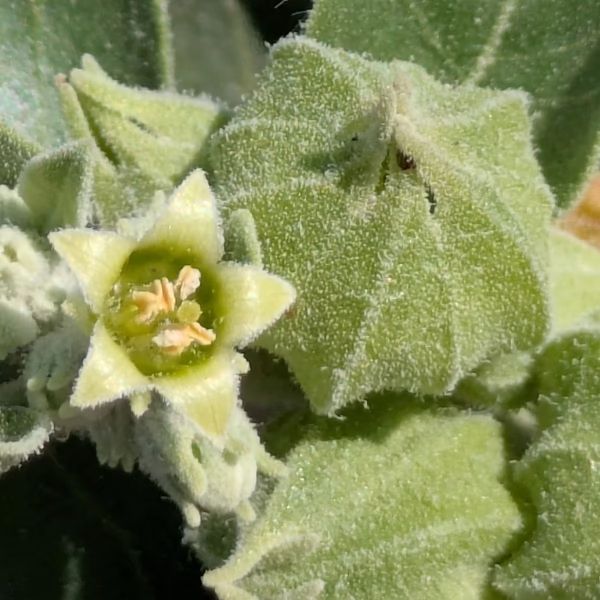
The small, usually greenish or yellow-green flowers arise in clusters in the leaf axils. The most conspicuous fruiting feature is the inflated, papery calyx, which grows larger after flowering and surrounds a glossy, spherical berry that ripens red, orange or brick-coloured. In POWO’s cited descriptions, the berry is roughly 5–8 mm across and the fruiting calyx considerably larger. The lantern-like calyx can suggest a Physalis, so identification should rely on the full combination of characters rather than the husk alone.
Geographical Distribution and Habitat of Withania somnifera
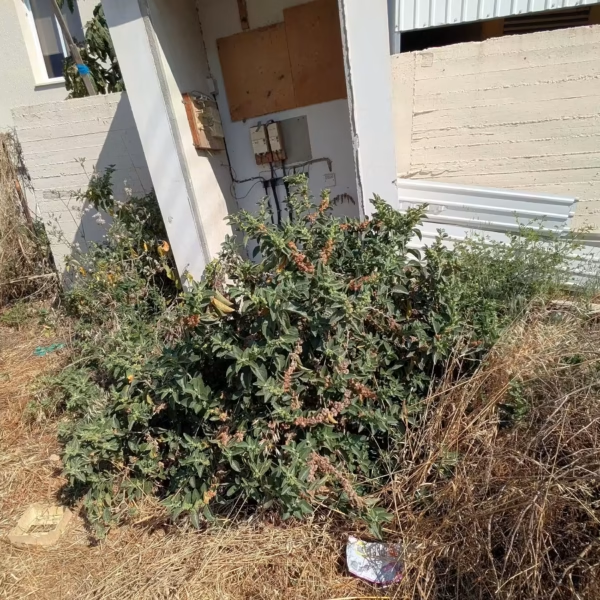
POWO gives the broad native range as southern Europe to central China and Africa to Myanmar, and describes the plant as a subtropical shrub or subshrub. Its cited floras report it from disturbed ground, roadsides, cultivated land and other open habitats. POWO records Cyprus within its native range, while RIS-ky describes it as an established alien on the island.
Distribution in Cyprus
RIS-ky records it on waste ground, roadsides and gardens, including locations around Polis Chrysochous, Pafos, Lemesos, Lefkosia, Larnaka, Agia Napa, Ammochostos and Rizokarpaso. The database describes it as established and cites earlier Cyprus floristic and vegetation works. Its own entry records 1862 as the first detection year and identifies escape from horticultural cultivation as a pathway.
Elevation Range in Cyprus
The species occurs primarily from sea level up to elevations of approximately 400 meters, preferring warm coastal microclimates and low-altitude inland valleys sheltered from severe winter frosts.
Flowering Period in Cyprus
Flowering in Cyprus typically takes place from early spring through the summer months (April to July), with fruiting bodies persisting well into the autumn season.
Conservation Status in Cyprus
According to assessments modeled alongside regional conservation parameters, the species is categorized as locally rare.
Is Withania somnifera Suitable for Gardens?
It can be grown as an ornamental or container shrub in a warm, sunny position with well-drained soil. North Carolina State University Extension describes it as suitable for pots and recommends full sun, good drainage and avoiding waterlogged soil. A European seed retailer currently lists seeds for sale.
Toxicity and Safety
Safety differs between the living plant and commercial preparations made from selected plant parts. North Carolina State University Extension flags the species as having poisonous characteristics and lists the flowers, fruit, leaves and roots among the parts of concern. Because this warning conflicts with casual claims online that parts of the plant are edible, do not treat berries or other home-harvested material as food. The NIH National Center for Complementary and Integrative Health (NCCIH) discusses supplement preparations separately and reports possible drowsiness, stomach upset, diarrhoea and vomiting, as well as rare cases linking supplements to liver injury.
NCCIH advises avoiding supplement use during pregnancy and not using it while breastfeeding; it also says the preparations are not recommended before surgery or for people with thyroid or autoimmune disorders. Possible interactions include medicines for diabetes or high blood pressure, immunosuppressants, sedatives, anticonvulsants and thyroid hormone medicines. NCCIH also advises that people with hormone-sensitive prostate cancer avoid use because testosterone may increase. Anyone taking medicines, managing a health condition, or considering a supplement should discuss it with a qualified clinician or pharmacist; a plant’s traditional use does not establish that an unstandardized home preparation is safe.
Medicinal Properties
Traditional use and plant chemistry
The root has a long history of use in Ayurvedic and Unani medical traditions. The NIH Office of Dietary Supplements (ODS) notes that root and leaf chemistry differ, and that most commercial products use root extract, while some use both root and leaf. The plant contains compounds including steroidal lactones called withanolides and alkaloids. These chemical constituents and historical use provide context for research; they do not by themselves prove that a preparation treats a disease.
What clinical studies suggest
NCCIH’s evidence review concludes that some preparations may help with stress and insomnia, while evidence for anxiety remains unclear and evidence is insufficient for many other promoted uses. ODS describes several small, short-duration randomized trials and a 2021 systematic review of seven studies involving 491 adults; the studies used different extracts, plant parts and doses, making it difficult to identify a reliable product or dose. Its review of five sleep studies involving 372 adults found a small but statistically significant improvement compared with placebo. These findings are preliminary and apply to the tested preparations and study populations, not automatically to the whole plant or every supplement on sale.
ODS also summarizes limited evidence that use over two to four months may increase testosterone levels and sperm quality, while NCCIH says there is not enough evidence to determine whether the plant helps with conditions such as diabetes, asthma, menopause, cognitive function or female infertility. Long-term safety and effectiveness remain insufficiently established. Clinical findings should therefore be read as early evidence about particular extracts, rather than proof of broad therapeutic claims.
Fascinating Insights About Withania somnifera
A botanical lantern around the berry
The papery structure around the ripe fruit is not a separate pod: it is the flower’s calyx, enlarged as the berry develops. Kew’s floristic descriptions show that the calyx becomes much larger than the small red fruit it encloses. This fruiting form helps explain why the species is sometimes mistaken for a Physalis, another nightshade genus known for an inflated calyx; the resemblance is useful for recognizing the family relationship, but not sufficient for identification on its own.
Its scientific name preserves two different stories
Withania commemorates Henry Witham, while somnifera refers to sleep. ODS explains that the Sanskrit name behind the best-known common name instead refers to “horse” and “smell.” These names preserve botanical and cultural histories, but they should not be read as clinical evidence: ODS and NCCIH both stress that health claims need to be judged from controlled studies of specific preparations.
Historical Lore in Traditional African Hunting
Ethnobotanical field studies documented by botanical explorers in southern Africa, such as specimen archives compiled by botanist B. Maguire, reveal that indigenous San and Khoisan communities traditionally utilized the crushed fruits and flowers of Withania somnifera as ritual charms during dangerous lion-hunting expeditions.