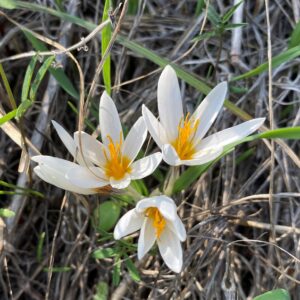
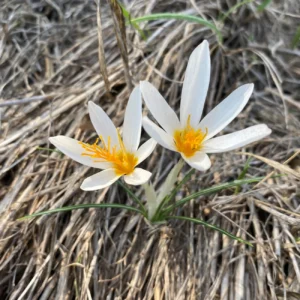
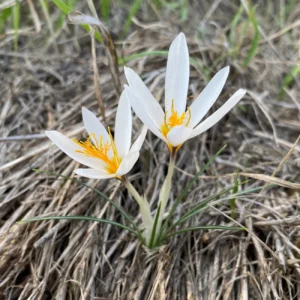
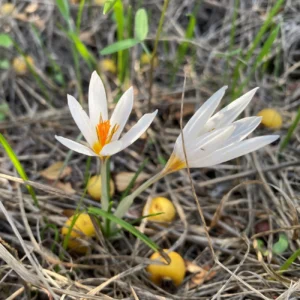
Crocus veneris, or the Venus Crocus, is a charming endemic geophyte found across the island of Cyprus. Featuring petals ranging from pure white to soft lilac, often adorned with violet-purple stripes on the exterior, this species is relatively frequent. It is not listed as endangered
Cypriot names
Αρκοσσιυλλί, Κρόκος της Αφροδίτης
Common English Names
The primary name is the Venus Crocus, directly referencing its scientific epithet.
Etymology of Crocus veneris
The etymology of the genus , "Crocus", derives from the Ancient Greek word "κρόκος", which is alleged of a Semitic origin. Latin borrowed this word, which received the meaning of the yolk, obviously due to the yellow color of the centre of this genus's flowers (stamens and pistil). Latin "veneris" is translated as "of Aphrodite", since Crocus veneris is an endemic plant of Cyprus, the birthplace of Aphrodite (Venus), hence "veneris".
Synonyms and Taxonomic History
This species has been historically documented under the name Crocus reticulatus var. veneris, reflecting early confusion between it and its relatives in the Levant. Botanical refinements have since established it as a distinct endemic species with a unique distribution pattern across the island’s varied mountain ranges.
Crocus in the Ancient Greek Mythology
Crocus, according to ancient Greek mythology, was a friend of the god Hermes. One day, while the two friends were playing, Hermes accidentally hit Crocus on the head and killed him. Where this event took place, a flower grew. Three drops of the unfortunate young man's blood fell into the centre of the flower and gave the spots to the initial species, which has since taken the name Crocus.
A second myth refers to the unrequited love of a young man, Crocus, for the nymph Smilaka which led to his transformation into the eponymous plant.
The Mythological Link of Crocus veneris with Aphrodite
The Venus Crocus bears its name from the mythological birth of Aphrodite from the sea foam off the coast of Paphos. It is believed that the crocuses sprang up wherever the goddess walked, cementing the plant's place in Cypriot folklore as a symbol of love and beauty.
Key Characteristics vs Other Crocus
To successfully identify the Venus Crocus, look for these specific features that distinguish it from the other endemic Crocus species:
- Anther Color: The anthers are bright yellow, a crucial feature separating it from the dark-anthered Crocus cyprius and Crocus hartmannianus.
- Corm Tunic: The corm is covered in a finely reticulated or netted tunic, which is less coarse than that of C. hartmannianus.
- Floral Pattern: The petals are primarily white or pale lilac, usually with three distinct purple stripes on the back of the outer segments.
- Flower Size: The blossoms are generally smaller and more numerous than those of the Crocus cyprius subspecies.
Botanical Structure and Morphology
Crocus veneris has white (to pink) flowers. Its height is only 8 cm.
Delicate Tuberous Corm
The Venus Crocus grows from a small, globose corm that serves as a storage organ during its summer dormancy. This corm is covered in a characteristic netted tunic of fine fibers, which protects it from desiccation and pathogens in the rocky soil. This structure allows the plant to survive in diverse conditions across the island.
Narrow Linear Foliage
The plant produces slender, grass-like leaves with a distinct longitudinal white stripe down the center. These leaves typically emerge alongside the flowers or shortly after, providing the necessary nutrients through photosynthesis to replenish the corm for the following spring.
Solitary Winter Blooms
The flowers are cup-shaped and emerge directly from the ground on a short tube, which helps them withstand harsh winter winds. The blossoms are highly sensitive to sunlight, opening wide during bright weather to attract pollinators and closing tightly during rain or cold nights to protect the pollen.
Geographical Distribution
Crocus veneris is a Cyprus, Island-Wide Endemic
The Venus Crocus is found exclusively on the island of Cyprus, making it a strict endemic. Unlike many other endemics that are restricted to a single mountain range, this species is widespread, occurring primarily in Kato Paphos, Agios Neophytos Monastery area, in Statos-Agios Fotios village and surrounding areas (Paphos district), in the area of Prophitis Ilias in Lythrodontas village (Nicosia district), in Akrotiri village (Limassol district), in Kornos village (Larnaca district), Pentadaktylos (Kyrenia) ranges, as well as the Akamas Peninsula.
Altitude and Habitat
This species is remarkably adaptable, found growing at elevations ranging from 100 to 925 meters. It thrives on rocky slopes, within open phrygana (scrubland), and in the understory of sparse pine forests. This wide altitudinal range makes it one of the most frequently encountered crocuses on the island.
Flowering Season
The flowering period for the Venus Crocus is extensive, stretching from late autumn (November) through to early spring (March). The timing of the bloom depends heavily on the altitude, with populations in the lower plains blooming much earlier than those in the Troodos mountains.
Conservation Status
Least Concern
The Venus Crocus is currently listed as a species of Least Concern in the Red Data Book of the Flora of Cyprus. Because of its wide geographical range and relatively frequent occurrence, it is not considered to be under immediate threat of extinction, unlike its more specialized endemic relatives.
Threats and Protection
Despite its relatively secure status, the species is still vulnerable to habitat fragmentation from tourism development, road construction, and the intensification of agriculture in lowland areas. In Cyprus, all wild species of Crocus are afforded general protection under national environmental legislation.
Habitat and Ecology
Rocky Slope Ecosystems
This crocus is perfectly adapted to the thin, rocky soils of Cyprus. It thrives in open, sunny locations where it does not have to compete with dense vegetation, often found growing in limestone or igneous gravel.
Early Pollinator Reliance
Blooming in the cooler months, the Venus Crocus is a critical food source for hardy pollinators, such as early-emerging bees and flies. These insects are essential for the pollination of the plant, ensuring the production of seeds for the next generation.
Is Crocus veneris Suitable For Gardens?
In terms of "Is Crocus veneris Suitable For Gardens?", it is critical to note that it is illegal to uproot or pick this endemic plant from the wild in Cyprus. While legally protected, the Venus Crocus can be difficult to cultivate in typical garden soil, as it requires extremely well-drained, nutrient-poor conditions similar to its natural rocky habitat.
How to find Crocus veneris in Cyprus:
The specimens of the pictures were found in Pentalia village (Paphos district), literally on the borders with the village of Galataria, at an elevation of approximately 700 metres. On the right turn towards Galataria from the main road, there is another turn on the right that heads towards the old village of Pentalia (there is an old and a new Pentalia village). Between those two asphalt roads, there is a third dirt road. Take the dirt road and keep driving straight for approximately 300 metres and a Crocus veneris colony exists on the right side below the first olive tree that you will see next to the road.