Date Created: 18.04.2022
Last Modified: 03.10.2026
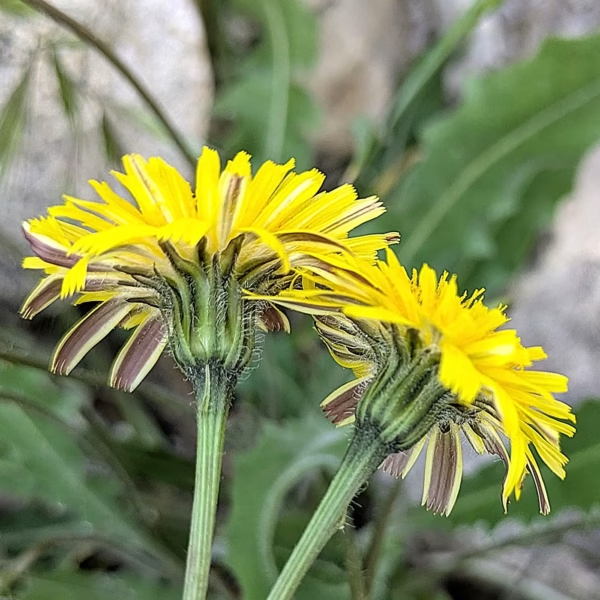
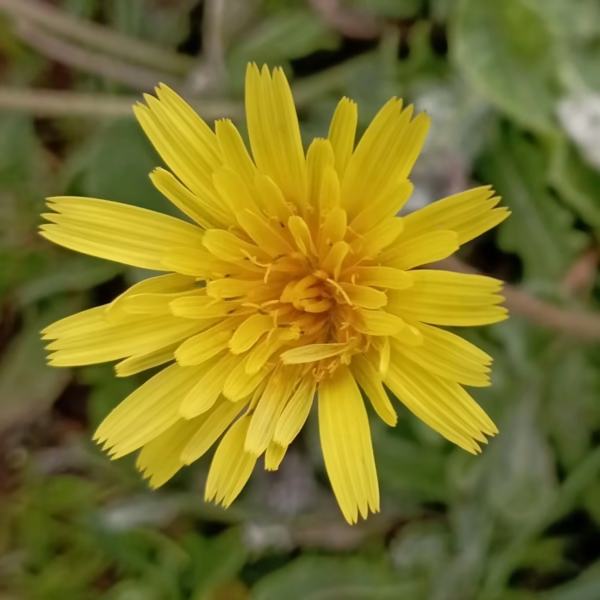
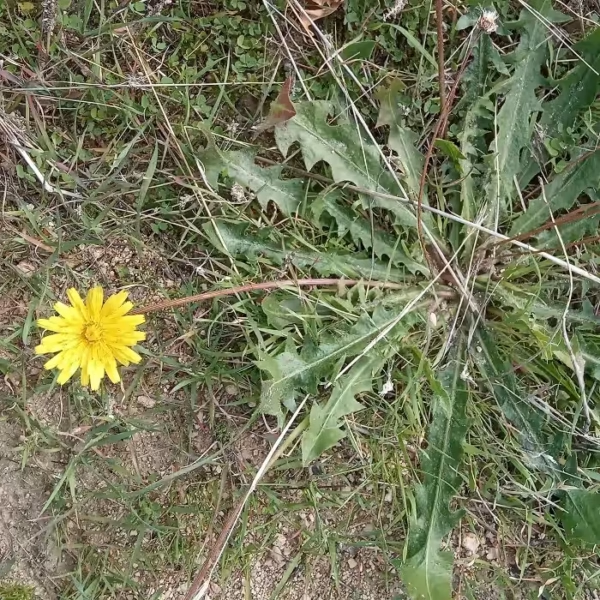
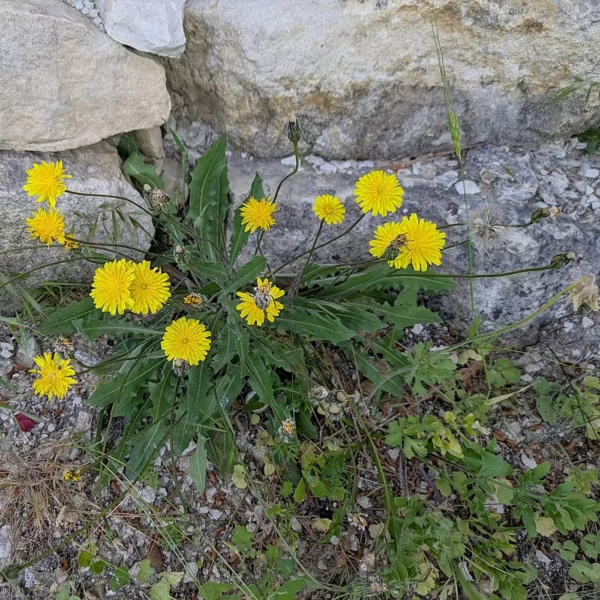
Leontodon tuberosus L., commonly called tuberous hawkbit, is a Mediterranean perennial belonging to the daisy family, Asteraceae. Native to Cyprus, it produces yellow flower heads above a basal leaf rosette and develops swollen underground roots. It is indigenous but not endemic to the island.
Common Cypriot Names
The Modern Greek rendering is Λεοντόδοντας ο κονδυλώδης [Leontódontas onkondylódis], meaning “tuberous lion’s tooth”. The epithet refers to the swollen roots. This is a Greek rendering of the scientific name, not evidence of a distinct Cypriot dialect name.
Common English Names
- Tuberous hawkbit
- Bulbous dandelion
Etymology of Leontodon tuberosus
The etymology of the genus name Leontodon comes from the Ancient Greek λέων [léon], meaning “lion”, and ὀδούς [odoús], meaning “tooth”, referring to the toothed leaves found in the genus. The Latin epithet tuberosus means “tuberous” and refers to the swollen roots. The University of Trieste’s botanical account confirms both botanical references.
Synonyms
POWO lists the following homotypic synonyms, presented from newest to oldest. Author abbreviations and publication years follow Kew’s record.
- Colobium tuberosum (L.) Holub (1973)
- Thrincia nudicaulis subsp. tuberosa (L.) P.Fourn. (1940)
- Thrincia hispida subsp. tuberosa (L.) R.C.V.Douin (1923)
- Spitzelia tuberosa (L.) Pomel (1875)
- Streckera tuberosa (L.) Fourr. (1869)
- Apargia bulbosa Balb. (1808) — an illegitimate, superfluous name.
- Thrincia tuberosa (L.) DC. (1805)
- Hyoseris tuberosa (L.) Savi (1798)
- Apargia tuberosa (L.) Martyn (1795)
- Picris tuberosa (L.) All. (1785)
Key Characteristics for Diagnostic Identification
The genus must be defined before comparing species. The Cyprus checklist retains Hedypnois separately. However, POWO currently accepts Leontodon rhagadioloides subsp. rhagadioloides (Hedypnois Rhagadioloides) in Cyprus. Consequently, an unqualified statement that the island has only one species of Leontodon would be misleading under Kew’s treatment. The comparison below includes this additional taxon.
The comparison uses Salvador Talavera and María Talavera’s treatment of the target species as Thrincia tuberosa, and L. Murray’s account of L. rhagadioloides in New South Wales Flora Online, edited by C. Herscovitch and P. G. Wilson. These are published species descriptions, not a newly validated key to Cypriot populations. Measurements should be interpreted accordingly.
- Life cycle and underground organs: The target species is perennial, with clustered tuberous roots. L. rhagadioloides is annual. Underground persistence is therefore useful, although a single photograph cannot establish a plant’s lifespan.
- Leaf position: The target species carries its foliage in a basal rosette, with scape-like flowering stems. L. rhagadioloides also produces basal leaves but has smaller, partly stem-clasping cauline leaves.
- Leaf outline: The target species commonly has backward-pointing lobes and a prominent terminal lobe. Murray describes the basal leaves of L. rhagadioloides as entire or toothed. Both can have oblanceolate blades and blunt tips, so general blade shape overlaps.
- Flowering stalks: The target species has longitudinally ribbed, scape-like stems, generally without bracts. L. rhagadioloides has hollow peduncles swollen below the involucre. Do not rely on swelling alone: the target species’ stems can also widen beneath the head.
- Principal involucral bracts: The target species generally has eight principal bracts, accompanied by shorter supplementary ones; Murray records 10–16 inner bracts for L. rhagadioloides. Count comparable bract series, not every visible scale.
- Fruit differentiation: Both taxa produce different peripheral and central fruits. This shared feature does not separate the target species from L. rhagadioloides; the form of the central pappus is more informative.
- Peripheral pappus: The target species’ outer fruits carry a short scaly crown. L. rhagadioloides likewise has a small coroniform outer pappus. A crown on an outer fruit is therefore not sufficient for identification.
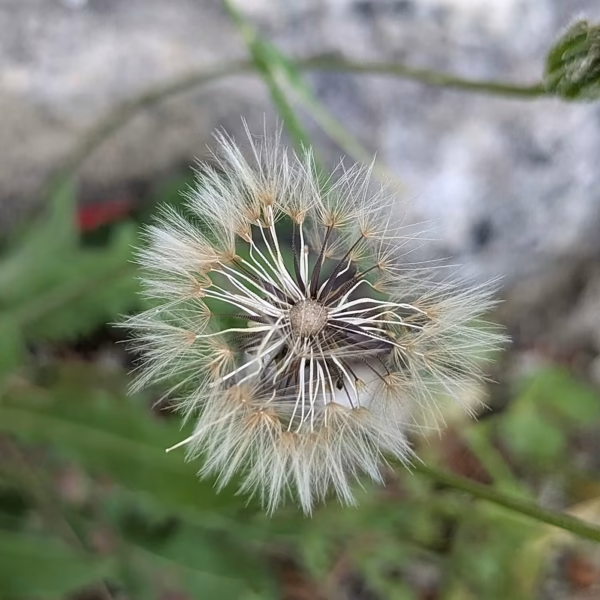
- Central pappus: The target species has 18–20 feathery scales, shed at maturity. In L. rhagadioloides, Murray records five or six awns; other botanical descriptions characterise these as coarse and scabrid. Examine intact central fruits with magnification.
Additional Identification Characteristics
Talavera, Talavera and Sánchez’s 2015 key additionally identifies the target species by its usually blackish style branches and narrow, elongated petioles. These supplement the tuberous roots and feathery central pappus. A corresponding, securely verified style-colour distinction for the Cypriot L. rhagadioloides population was not established, so none is claimed here.
The expanded genus follows the molecular and phytochemical investigation by Neela Enke, Birgit Gemeinholzer and Christian Zidorn, published online in 2011 and in the 2012 journal volume. They proposed including Hedypnois within Leontodon. This is a change in classification, not evidence that the comparison species recently arrived in Cyprus.
Botanical Structure and Floral Details of Leontodon tuberosus
Hair Structure
The Flora iberica description records two- or three-branched hairs on leaves and stems, but also permits hairless specimens. Hairs on the backs of the involucral bracts are generally simple. Hair distribution and branching should therefore be recorded separately for each organ.
Flower-Head Development
Heads are solitary, nodding before opening and erect at maturity. The florets are yellow; inner ligule teeth are often purplish. These developmental and colour details supplement identification but are not presented as individually exclusive characters.
Geographical Distribution and Habitat of Leontodon tuberosus
The native range extends across the Mediterranean region, including southern Europe, North Africa, Cyprus and the eastern Mediterranean. The University of Trieste documents habitats including open grassland, olive groves and clearings in Mediterranean scrub, with soil that dries during summer. These describe the species’ wider ecology, rather than an independently verified inventory of its Cypriot habitats.
Distribution in Cyprus
The dynamic checklist records the species as indigenous in all eight phytogeographical divisions of Cyprus. These are botanical recording divisions, not the island’s administrative districts. Its distribution is therefore island-wide at the recording-division scale.
Elevation Range in Cyprus
The published Cyprus elevation range is 0–1,225 metres above sea level. The dynamic checklist attributes this range to Meikle’s Flora of Cyprus, Volume 2 (1985). It is a documented range, not proof that occurrence outside those elevations is impossible.
Flowering Period in Cyprus
The Cyprus checklist gives (December–)February–May: flowering normally runs from February to May, with an earlier start sometimes recorded in December.
Is Leontodon tuberosus Suitable for Gardens?
The species is offered for garden sowing: the Israeli supplier Seeds from Zion lists seed and provides cultivation instructions. This confirms commercial availability outside Cyprus.
Toxicity and Safety
The available research does not establish unrestricted human safety. E. Attard and A. Cuschieri, affiliated with the University of Malta’s agricultural and medical departments, included this species in a 2009 laboratory screening of Asteraceae extracts. Such preliminary assays cannot establish safe food portions, medicinal doses, pregnancy safety, drug interactions or safety for pets. Their paper is not a clinical safety assessment.
Published references to culinary use and laboratory bioactivity must be distinguished from evidence that a preparation is safe for everyone. No validated medicinal dose is supplied here. The studies consulted do not justify describing the plant as universally “non-toxic” or recommending homemade concentrated extracts.
Medicinal Properties
Laboratory Research in Cyprus
In 2024, Atalanti Christou and colleagues at the Cyprus University of Technology investigated extracts from twelve native plants. Their specimens came from Limassol District and were identified by Dr Nikolaos Nikoloudakis. Extracts of Leontodon tuberosus inhibited carbohydrate-digesting enzymes in laboratory assays, supporting further investigation of their constituents.
What the Findings Do Not Establish
Enzyme inhibition in a laboratory does not demonstrate treatment of diabetes in humans. The study used prepared extracts and did not test a therapeutic regimen in patients. Its findings establish neither clinical efficacy nor a safe dose. No human clinical trial demonstrating medicinal benefit was identified in the sources reviewed for this account.
Fascinating Insights About “Leontodon tuberosus”
Only Eight Chromosomes
The chromosome database maintained at Tel Aviv University records a somatic chromosome count of 2n = 8 from the Cyprus material investigated by botanists Robert Vogt and Abelardo Aparicio. Their 1999 study concerned plants collected during the fourth Iter Mediterraneum expedition, providing a Cyprus-specific cytological record.
A Source of a Newly Described Natural Compound
In 2004, Renate Spitaler, Ernst-P. Ellmerer, Christian Zidorn and Hermann Stuppner, researchers in pharmacognosy and organic chemistry at the University of Innsbruck, reported a previously undescribed eudesmane derivative isolated from this species. They established its structure using mass spectrometry and nuclear magnetic resonance spectroscopy. This was a chemical discovery, not a demonstration of medicinal effectiveness.