Date Created: 12.04.2026
Last Modified: 12.04.2026
Ballota nigra subsp. meridionalis is a robust perennial herb belonging to the Lamiaceae family, commonly known as the Southern Black Horehound. In Cyprus, this plant is an indigenous taxon typically found in nitrogen-rich soils and disturbed environments. A common synonym frequently encountered in Mediterranean botanical literature for this specific subspecies is Ballota nigra subsp. foetida.
Cypriot Names
The official Latin name translated into Greek is Μπαλλωτή η μέλαινα υποείδος το μεσημβρινό.
Common English Names
- Southern Black Horehound
- Straight-toothed Horehound
- Mediterranean Horehound
Etymology of Ballota nigra subsp. meridionalis
The etymology of the genus name Ballota originates from the Ancient Greek word "Βαλλωτή" [vallote], a name used by Dioscorides (which is probably of Pre-Greek origin) to describe this specific plant. The name is believed to be derived from βάλλω [vallo], meaning "to reject," possibly referring to the fact that grazing animals usually avoid the plant due to its bitter taste and strong odor.
The specific epithet "nigra" is Latin for "black," which describes the way the plant turns dark or blackish upon drying. The subspecific epithet meridionalis is derived from the Latin "meridies", meaning "south" or "midday," indicating its southern Mediterranean distribution, while the synonym foetida refers to the strong, often unpleasant scent emitted by the foliage when it is crushed.
Synonyms
- Ballota nigra var. meridionalis Bég. (1903)
- Ballota nigra subsp. foetida (Vis.) Hayek (1929)
- Ballota nigra var. foetida Vis. (1847)
- Ballota alba L. (1753)
- Ballota borealis Schweigg. (1812)
- Ballota nigra var. alba (L.) Tinant (1836)
- Ballota nigra f. borealis (Schweigg.) Bolzon (1905)
- Ballota porrigens Peterm. (1845)
- Ballota nigra var. porrigens (Peterm.) Peterm. (1846)
- Marrubium ballota E.H.L.Krause (1903)
- Ballota nigra var. aurea Thys & Antoine (1869)
- Ballota nigra variegata Abbey (1864)
Key Characteristics for Diagnostic Identification
According to the definitive botanical keys established by Robert Desmond Meikle in his comprehensive Flora of Cyprus (1985), this subspecies is distinguished from the only other local taxon, Ballota nigra subsp. ruderalis, by the following morphological differences:
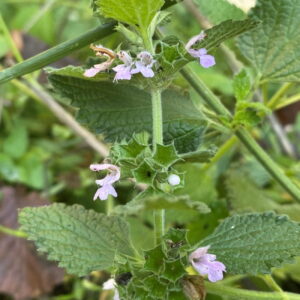
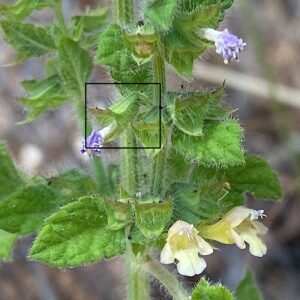
- Mucro Shape: The calyx teeth of Ballota nigra subsp. meridionalis terminate in a strictly straight or slightly spreading mucro, whereas the teeth of Ballota nigra subsp. ruderalis are characterized by a distinctly hooked or curved mucro at the apex.
- Tooth Proportions: The calyx teeth in this subspecies are notably narrower and more slender-acuminate, standing in contrast to the broadly ovate-triangular teeth of subsp. ruderalis which are notably broader at the base.
- Verticillaster Density: The flowers are arranged in axillary clusters that are often less populated and appear on slenderer stems compared to the very dense, many-flowered, and crowded verticillasters characteristic of Ballota nigra subsp. ruderalis.
Botanical Structure and Floral Details of Ballota nigra subsp. meridionalis
Vegetative Morphology
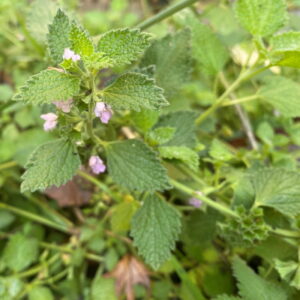
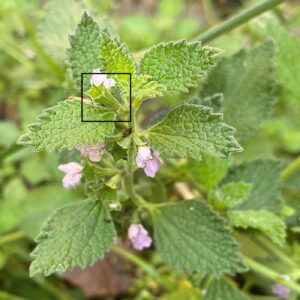
The stems of Ballota nigra subsp. meridionalis are four-angled and covered in fine, spreading or downward-pointing hairs. The leaves are opposite, petiolate, and have a wrinkled, rugose surface with coarsely toothed margins. This pubescent, textured foliage is a typical adaptation for Mediterranean plants to manage transpiration in high-temperature environments.
Reproductive Organs
The flowers are zygomorphic with a two-lipped purple or pinkish corolla. The calyx is the most distinct part of the reproductive structure, featuring a tubular shape with ten prominent nerves. The way the teeth remain straight or spreading at the tip is the definitive trait that aids in subspecific identification.
Geographical Distribution and Habitat of Ballota nigra subsp. meridionalis
This subspecies is distributed across the Mediterranean region, from Southern Europe to North Africa and Western Asia. In Cyprus, it is a common indigenous plant. It typically grows in nitrogen-rich soils, near livestock pens, along stone walls, and in abandoned agricultural fields.
Distribution in Cyprus
The plant is widespread throughout the island, with frequent sightings in the Troodos foothills, the Mesaoria plain, and the Paphos district. It is particularly common in village outskirts where the soil has been enriched by organic waste. It is rarely found in pristine forest environments, preferring disturbed ground.
Elevation Range in Cyprus
In the Cypriot landscape, this taxon is primarily encountered from sea level up to approximately 900 meters. While it is most abundant in the lowlands and the hilly central regions, it can occasionally be found at slightly higher altitudes in the Troodos range, provided the habitat remains sufficiently nitrogenous and disturbed by human or animal activity.
Flowering Period in Cyprus
The flowering period typically occurs from April to July, matching the peak growth season of many perennial labiates on the island. The bright purple flowers are most conspicuous in May and June, providing a nectar source for bees and other insects before the driest months of late summer begin.
Conservation Status in Cyprus
According to current botanical assessments, this taxon is categorized as Least Concern (LC). It is a highly resilient and adaptable plant that frequently benefits from human-led environmental changes. Its populations are stable and widespread, showing no signs of significant decline or immediate threat in the Cypriot landscape.
Is Ballota nigra subsp. meridionalis Suitable for Gardens?
This subspecies can be used in wild or nectar-focused gardens to support local biodiversity. It is exceptionally hardy and requires very little irrigation once established. Because of its vigorous growth and ability to spread in nitrogen-rich soil, it is best suited for larger, informal garden areas rather than refined borders.
Toxicity and Safety
There are no recorded cases of acute toxicity for humans, but the plant is generally avoided by livestock due to its bitter chemical constituents. It contains diterpenes and volatile oils that give it its "stinking" reputation. As with most aromatic herbs, it should be handled with care if intended for any internal use.
Medicinal Properties
In traditional Mediterranean folk medicine, Black Horehound has been used for its supposed anti-spasmodic and sedative effects. It was sometimes prepared as an infusion to treat symptoms of menopause or nervous dyspepsia. However, its use in Cyprus is less common than other more pleasantly scented Lamiaceae species like mint or thyme.
Fascinating Insights About Ballota nigra subsp. meridionalis
Evolutionary Divergence in Calyx Morphology
Phylogenetic studies of the Ballota nigra complex indicate that the subtle shift from hooked to straight calyx teeth represents a significant evolutionary adaptation. While the hooked mucro of subsp. ruderalis facilitates epizoochory (dispersal by animals), the straight-toothed morphology of subsp. meridionalis suggests a divergent strategy possibly linked to different environmental pressures or localized pollinator interactions within the Mediterranean basin.
Phytochemical Defense and Terpenoid Profile
Authoritative biochemical analysis confirms that Ballota nigra subsp. meridionalis produces a sophisticated array of diterpenoids, specifically labdane diterpenes such as ballotinone. These secondary metabolites are not merely for scent; they are clinically recognized for their potent antifeedant properties, providing the plant with a robust, scientifically-proven defense system against a wide variety of Mediterranean herbivores and insect pests.
Ecological Role as a Nitrogen Indicator
Ecological field assessments establish this subspecies as a primary bio-indicator of anthropogenic and zoogenic soil nitrogen enrichment. Its presence is highly correlated with historical land management practices in Cyprus. By colonizing these high-nitrate environments, the plant facilitates soil stabilization and provides essential early-summer resources for hymenopteran species, cementing its role as a critical component of regional biodiversity.