Date Created: 29.10.2022
Last Modified: 12.04.2026
Ballota nigra subsp. ruderalis is a robust, perennial herb belonging to the Lamiaceae family. Commonly known as Black Horehound, this taxon is frequently found in disturbed habitats, roadsides, and waste ground. A frequent synonym often encountered in botanical literature for this subspecies is Ballota nigra subsp. foetida, a name that reflects the plant’s distinct and somewhat pungent aroma.
Cypriot Names
The official Latin name translated into Greek is Μπαλλωτή η μέλαινα υποείδος το ανδροκλαστικό.
Common English Names
- Black Horehound
- Stinking Horehound
- Common Black Horehound
Etymology of Ballota nigra subsp. ruderalis
The etymology of the genus name Ballota originates from the Ancient Greek word "Βαλλωτή" [vallote], a name used by Dioscorides (which is probably of Pre-Greek origin) to describe this specific plant. The name is believed to be derived from βάλλω [vallo], meaning "to reject," possibly referring to the fact that grazing animals usually avoid the plant due to its bitter taste and strong odor.
The specific epithet nigra is Latin for "black," which describes the way the plant turns dark or blackish upon drying. The term "ruderalis", translated as "ruderal" is derived from the Latin "rudus, ruder" meaning "rubble, debris" + the suffix "-alis"; a ruderal species refers to any plant that is the first to colonize land after a disturbance removing competition.
Synonyms
- Ballota nigra subsp. foetida
- Ballota foetida
- Ballota ruderalis
Key Characteristics for Diagnostic Identification
According to the definitive botanical keys established by Robert Desmond Meikle in his comprehensive Flora of Cyprus (1977, 1985), this subspecies is distinguished from the only other local taxon, Ballota nigra subsp. meridionalis, by the following morphological differences:
- Mucro Shape: The calyx teeth of Ballota nigra subsp. ruderalis terminate in a strictly straight, short mucro, whereas the teeth of Ballota nigra subsp. meridionalis are characterized by a distinctly hooked or curved mucro at the apex, whilst the mucro of meridionalis is straight.
- Tooth Proportions: The calyx teeth in this subspecies are broadly ovate-triangular and roughly as broad as they are long, while the teeth of subsp. meridionalis are notably narrower, more elongated, and slender-acuminate.
- Verticillaster Density: The flowers are arranged in dense, many-flowered axillary clusters that are typically more crowded and contain a higher number of individual flowers than the often less-populated and slenderer clusters of its local counterpart.
Botanical Structure and Floral Details of Ballota nigra subsp. ruderalis
Vegetative Morphology
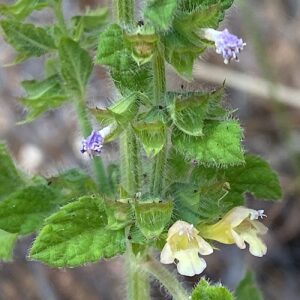
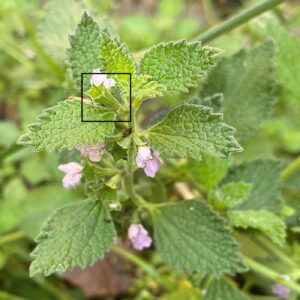
The stems of Ballota nigra subsp. ruderalis are four-angled, often flushed with purple, and covered in downward-pointing (retrorse) hairs. The leaves are arranged oppositely and have a characteristic wrinkled (rugose) surface. This texture, combined with the dense pubescence, helps the plant regulate its temperature in exposed, sun-drenched Mediterranean environments.
Reproductive Organs
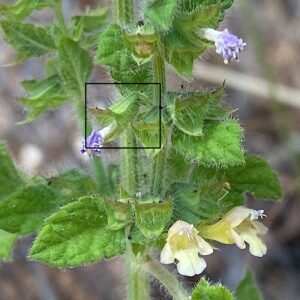
The flowers are zygomorphic and prominently two-lipped. The upper lip is concave and protects the four stamens, while the lower lip provides a landing platform for pollinators. The calyx teeth are particularly diagnostic in this subspecies, as they are typically wider and less needle-like than in other variations of the species.
Geographical Distribution and Habitat of Ballota nigra subsp. ruderalis
This subspecies is widely distributed across Europe, North Africa, and Western Asia. In Cyprus, it is a common indigenous plant. It typically grows in nitrogen-rich soils, near livestock pens, along stone walls, and in abandoned agricultural fields.
Distribution in Cyprus
The plant is widespread throughout the island, with frequent sightings in the Troodos foothills, the Mesaoria plain, and the Paphos district. It is particularly common in village outskirts where the soil has been enriched by organic waste. It is rarely found in pristine, climax forest environments, preferring disturbed ground.
Flowering Period in Cyprus
The flowering period of this perennial typically occurs from April to July. The peak bloom is usually observed in May and June, providing a splash of purple in the drying landscapes of early summer. During this time, the plant is highly attractive to various long-tongued insects, especially bumblebees.
Conservation Status in Cyprus
According to current botanical assessments, this taxon is categorized as Least Concern (LC). It is a highly adaptable plant that benefits from human-induced soil disturbance. Its populations are stable across Cyprus, and it does not currently face any significant threats from land use changes or environmental shifts.
Is Ballota nigra subsp. ruderalis Suitable for Gardens?
While some might consider it a weed due to its vigorous growth, it is an excellent addition to a wildlife or "wild" garden. It is extremely hardy and requires very little water once established. Its ability to thrive in poor, nitrogen-heavy soils makes it useful for reclaiming neglected corners of a garden where other ornamentals might fail.
Toxicity and Safety
There are no known significant toxic effects for humans associated with this plant, and it is generally avoided by grazing animals due to its bitter taste. However, like many members of the Lamiaceae family, it contains essential oils and diterpenes that should be used with caution and professional guidance if intended for consumption.
Medicinal Properties
In traditional herbal medicine, infusions of this plant have been used for their sedative and anti-spasmodic properties, often cited for treating nausea or mild anxiety. Modern phytotherapy sometimes utilizes it for its potential to soothe nervous coughs. Despite these uses, it is not as widely used in Cyprus as other aromatic herbs like sage or oregano.
Fascinating Insights About Ballota nigra subsp. ruderalis
Nitrogen Bio-Indicator
One of the most fascinating insights into this plant is its role as a bio-indicator for high nitrogen levels in the soil. Its presence often marks areas where animals have congregated or where organic waste has been deposited. This makes it a botanical "map" of historical land use and soil enrichment in the Cypriot countryside.
Chemical Deterrents for Survival
The strong, unpleasant odor emitted when the leaves are crushed is a highly effective evolutionary defense mechanism. This chemical profile consists of volatile compounds that signal to herbivores that the plant is unpalatable. This allows the plant to survive in high-pressure grazing areas where more "tasty" vegetation is quickly cleared away.
Strategic Seed Persistence
The seeds of this subspecies are known for their longevity in the soil seed bank. They can remain dormant for several years, waiting for the soil to be disturbed or for a "ruderal" opportunity to arise. This strategy ensures that the population can quickly re-establish itself following agricultural tilling or construction activities.