Date Created: 20.03.2022
Last Modified: 02.04.2026
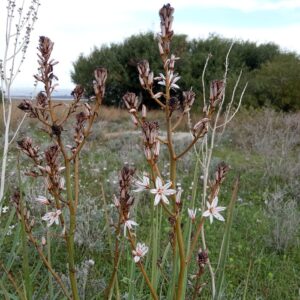
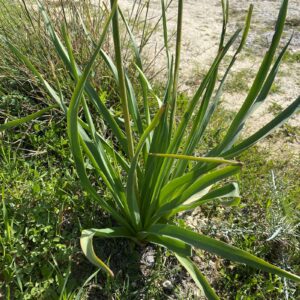
Asphodelus ramosus L. is the Latin name for the Branched Asphodel, a robust perennial belonging to the Asphodelaceae family, often cited by the synonym Asphodelus aestivus auct. mult. Its tall, white-flowered spikes are a ubiquitous and dramatic feature of the Cyprus spring. This species is easily recognized by its large, sword-shaped leaves and highly branched flowering stems that dominate open landscapes.
Common Cypriot Names
Ασφόδελος ο πολύκλαδος, Σπουρτούλλα
Common English Names
- Branched Asphodel
- Tall Asphodel
Etymology of Asphodelus ramosus
The etymology of the genus name Asphodelus is derived from the Ancient Greek "ἀσφόδελος" [asphódelos], a word of uncertain Pre-Greek origin historically associated with the meadows of the underworld. The species name ramosus comes from the Latin "ramus," meaning "branch," which refers to the characteristic branching nature of its tall, sturdy inflorescence.
Synonyms
- Asphodelus aestivus auct. mult.
- Asphodelus microcarpus Viv.
How To Identify Asphodelus ramosus
According to the definitive botanical keys established by Robert Desmond Meikle (1923–2021) in his comprehensive Flora of Cyprus, this species is distinguished by several specific morphological features, which separate it from its local relatives, Asphodelus fistulosus and Asphodelus tenuifolius:
Inflorescence Branching: Asphodelus ramosus features a large, robust, and complexly branched panicle. In contrast, Asphodelus fistulosus usually has a simple or only sparingly branched inflorescence, while Asphodelus tenuifolius typically presents a much more slender, simpler structure.
Leaf Morphology and Structure: The leaves are broadly sword-shaped, flat, and fibrous, reaching up to 4 cm in width. Asphodelus fistulosus and Asphodelus tenuifolius both possess cylindrical, hollow (fistulose) leaves that are significantly narrower and more grass-like than the broad blades of the branched species.
Root System and Longevity: This species is a true perennial with a cluster of thick, spindle-shaped tuberous roots. While Asphodelus fistulosus is also a perennial with shorter, slender roots, Asphodelus tenuifolius is typically a much smaller annual or short-lived perennial with a less developed root system.
Tepal and Flower Size: The flowers are relatively large with tepals 10–15 mm long. The flowers of Asphodelus fistulosus are slightly smaller (7–12 mm), and Asphodelus tenuifolius has the smallest flowers of the three, with tepals often measuring only 3–5 mm in length.
Capsule and Seed Shape: The fruiting capsules are large (5–10 mm) and obovoid. Asphodelus fistulosus has smaller, more globose capsules (4–6 mm), while Asphodelus tenuifolius produces very small, rugose (wrinkled) capsules that are distinctly different in texture and size.
Botanical Structure of Asphodelus ramosus
The Inflorescence
The flowering stalk is exceptionally robust and leafless, branching repeatedly to form a massive panicle. Each branch bears numerous flowers in a moderately dense raceme, creating a candelabra-like effect that makes the plant visible from a great distance across the rocky Cypriot hillsides and plains.
Floral Details
The individual flowers are star-shaped and hermaphroditic, consisting of six spreading tepals. The stamens have filaments that are widened at the base to protect the nectar, a specific adaptation for its pollinators. The contrast between the bright white petals and the dark central vein is a primary diagnostic marker.
Geographical Distribution and Habitat of Asphodelus ramosus
Asphodelus ramosus is widely distributed across the Mediterranean Basin, extending into Western Europe and North Africa. It is a highly resilient species, thriving in habitats ranging from sea level to high mountain altitudes, often acting as a pioneer species in areas that have been disturbed or overgrazed.
Distribution in Cyprus
In Cyprus, Asphodelus ramosus is not endemic but is extremely common and indigenous. It is found in all botanical divisions across the island, from coastal sands to the peaks of the Troodos and Kyrenia ranges. It is particularly prevalent in degraded phrygana and abandoned agricultural lands.
Is Asphodelus ramosus Suitable for Gardens?
This species is occasionally used in xeriscaping due to its dramatic architectural form and minimal water requirements. While not as common in commercial nurseries as ornamental lilies, it is prized by enthusiasts of Mediterranean flora. It requires full sun and exceptionally well-drained soil to prevent its tuberous roots from rotting.
Toxicity of Asphodelus ramosus
The plant is generally avoided by livestock because its tissues contain raphides (needle-like crystals of calcium oxalate). While not acutely lethal in small quantities, these crystals cause intense irritation to the mouth and digestive tract. Consequently, the presence of dense asphodel stands is often a reliable indicator of heavy overgrazing.
Medicinal Properties of Asphodelus ramosus
Historically, the tuberous roots were utilized in traditional Mediterranean medicine for their diuretic and emmenagogue properties. In ancient times, the crushed tubers were also applied topically as a treatment for various skin conditions, including ulcers and inflammations.
Modern pharmacological studies have investigated the presence of anthraquinones and polyphenols within the roots. These compounds exhibit potential antimicrobial and antioxidant activities. However, due to the presence of irritating oxalates, internal use in contemporary herbalism is rare and generally discouraged without professional pharmaceutical processing.
Fascinating Facts About Asphodelus ramosus
Connection to the Underworld
In Ancient Greek mythology, the Asphodel Meadows were a section of the underworld where ordinary souls—those who were neither remarkably good nor evil—rested for eternity. Because of this association, the plant was frequently planted near graves and was considered a sacred link between the living and the dead.
Fire-Resistant Survival Strategy
The Asphodelus ramosus is a pyrophyte, meaning it is exceptionally well-adapted to survive wildfires. While the foliage may burn, the deep, fleshy tuberous roots remain unharmed underground. After a fire has cleared competing vegetation, the asphodel is often the first plant to emerge, fueled by its stored energy.
Ancient Source of Starch
Despite its toxicity when raw, the tubers were a known food source during times of famine in antiquity. By boiling or roasting the roots extensively, the harmful crystals were neutralized, and the starch could be extracted. The starch was also used historically to produce a strong adhesive paste for bookbinding and shoemaking.
Indicator of Land History
Because grazing animals refuse to eat it, a landscape covered in Asphodelus ramosus tells a story of the land’s past. It usually indicates that the area was once heavily grazed by goats or sheep, which consumed all other palatable vegetation, leaving the unpalatable asphodels to multiply and dominate the ecosystem.
Architectural Garden Drama
In modern landscape design, the plant is gaining appreciation for its "architectural" value. Its tall, skeletal flowering stalks persist long after the blooms have faded, providing a striking silhouette against the Mediterranean sunset. This dried structure also serves as a habitat for various small insects throughout the hot summer months.