Date Created: 02.04.2026
Last Modified: 02.04.2026
Asphodelus tenuifolius Cav. is the Latin name for the Slender-leaved Asphodel, a delicate annual belonging to the Asphodelaceae family. It is often cited by the synonym Asphodelus fistulosus var. tenuifolius. In the Cyprus landscape, this is the most diminutive of the asphodels and the rarest, appearing as a dainty, wiry herb in the most arid and saline environments.
Common Cypriot Names
Ασφόδελος ο λεπτόφυλλος
Common English Names
- Slender-leaved Asphodel
- Narrow-leaved Asphodel
Etymology of Asphodelus tenuifolius
The etymology of the genus name Asphodelus is derived from the Ancient Greek "ἀσφόδελος" [asphódelos], a word associated with the mythical meadows of the underworld. The species name tenuifolius is composed of the Latin "tenuis," meaning "slender" and "folium," meaning "leaf," describing its exceptionally fine, thread-like foliage.
Synonyms
- Asphodelus fistulosus var. tenuifolius (Cav.) Baker
- Asphodelus fistulosus subsp. tenuifolius (Cav.) Arcang.
- Asphodelus clavatus Roxb.
- Asphodelus maroccanus Gand.
- Asphodelus microcarpus var. tenuifolius (Cav.) Ball
- Verinea tenuifolia (Cav.) Pomel
How To Identify Asphodelus tenuifolius
According to the definitive botanical keys established by Robert Desmond Meikle (1923–2021) in his comprehensive Flora of Cyprus, this species is distinguished by several specific morphological features. It looks more similar to A. fistolosus and here is the comparison:
- Inflorescence Branching: It features a very slender, often unbranched or strictly few-branched flowering stem, lacking the robust, tree-like panicle structure of Asphodelus ramosus.
- Leaf Morphology: The leaves are hollow (fistulose) but remarkably slender and thread-like, usually only 1–2 mm in diameter, distinguishing it from the broader hollow leaves of Asphodelus fistulosus.
- Root System: This species is an annual with a small, simple fibrous root system, lacking the thick, spindle-shaped tuberous storage roots characteristic of Asphodelus ramosus.
- Tepal Size: The flowers are the smallest in the genus for the region, with tepals measuring only 3–5 mm in length, whereas Asphodelus fistulosus tepals are 7–12 mm.
- Capsule Texture: The fruiting capsules are very small (3–4 mm) and uniquely characterized by a rugose or wrinkled surface, a vital diagnostic difference from its smooth-capsuled relatives.
Botanical Structure of Asphodelus tenuifolius
The Inflorescence
The flowering stalk is thin, smooth, and typically reaches a height of only 15–40 cm in Cyprus. The flowers are arranged in a lax, elongated raceme. Because the stem is so slender, the plant often sways significantly in the wind, giving it a delicate appearance in the field.
Floral Details
The tiny, star-shaped flowers are white or pale pink, featuring a distinct dark brownish-purple median nerve on each tepal. The stamens are notably short, and the filaments are slightly dilated at the base. Despite their small size, they follow the symmetrical hexamerous arrangement typical of the genus.
Geographical Distribution and Habitat of Asphodelus tenuifolius
Asphodelus tenuifolius has a vast native range extending from the Mediterranean and Northern Africa through the Middle East to India. It is a highly drought-tolerant species that thrives in semi-desert conditions, often appearing in sandy soils, saline flats, and heavily degraded arid pastures.
Distribution in Cyprus
In Cyprus, Asphodelus tenuifolius is not endemic but is an indigenous species. It is found primarily in the lowland areas of the Mesaoria plain (Division 4) and coastal regions near Famagusta and Larnaca. It occurs at altitudes from sea level up to approximately 150 meters.
Flowering Period in Cyprus
In the Cypriot climate, this species has a relatively short and early reproductive window. It typically flowers from January to March, though in particularly dry or warm years, the blooming period may conclude by late February as the plant quickly transitions to seed.
Is Asphodelus tenuifolius Suitable for Gardens?
This species is almost never found in cultivation in Cyprus. Due to its annual nature and very small flowers, it lacks the ornamental impact of Asphodelus ramosus. However, it is an excellent candidate for specialist "dry-meadow" restorations that aim to replicate authentic, arid coastal ecosystems.
Toxicity of Asphodelus tenuifolius
Like all asphodels, it contains calcium oxalate crystals that serve as a physical defense against grazing. While its small size makes it less of a concern for livestock, it remains unpalatable. In agricultural settings, it is often treated as a weed because it competes for moisture in sandy fields.
Medicinal Properties of Asphodelus tenuifolius
In certain traditional systems of medicine within its broader range, the seeds are used for their perceived diuretic and cooling properties. They are sometimes ground into a powder to treat inflammatory skin conditions. However, there is no significant documented history of medicinal use for this specific species in Cyprus.
Fascinating Facts About Asphodelus tenuifolius
The Arid Specialist
Asphodelus tenuifolius is a true specialist of "dusty" landscapes. While its relatives prefer rocky hillsides or roadsides, this species is often found in the most barren, sun-baked patches of earth where the soil is thin and competition for nutrients is minimal.
Rapid Life Cycle
As an annual, this plant has mastered the "race against time" in the Mediterranean climate. It germinates rapidly following winter rains and completes its lifecycle before the intense heat of late spring arrives. This ephemeral strategy allows it to bypass the harshest summer months.
Wrinkled Capsule Mystery
The rugose (wrinkled) texture of its seed capsules is a unique trait among the asphodels in Cyprus. This texture may play a role in seed protection or dispersal, potentially helping the seeds catch on the fur of passing animals in the sandy environments it inhabits.
Indicator of Salinity
In many parts of its range, this species acts as a biological indicator of soil salinity. Its presence often suggests that the ground has a higher salt content. It is one of the few asphodels capable of maintaining its physiological balance in such challenging, saline conditions.
Miniature Architecture
Despite its small stature, the plant reveals a perfectly scaled-down version of the classic asphodel architecture. It provides a vital food source for small, specialist pollinators in the early spring, playing a subtle but important role in the biodiversity of the island's fragile ecosystems.
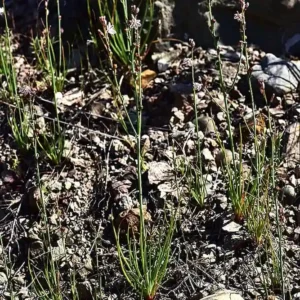
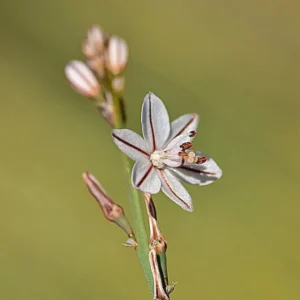
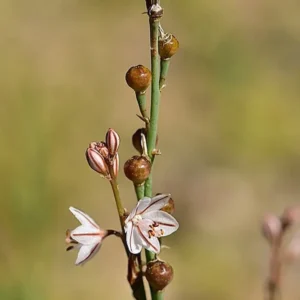
Image Credits: Sami Tamson